
Page Contents
- Why Naive Simulators Hit a Brick Wall in Part 2
- AoC’s Recurring Assembly and Hardware Genre
- Clean Fetch-Decode-Execute Architecture
- Cycle-Accurate Clock Telemetry
- Part 2 Survival — Peephole Optimisation and Backward Decompilation
- Boolean Gate Networks and Structural Adder Diagnostics
- AoC Examples
Why Naive Simulators Hit a Brick Wall in Part 2
Every Advent of Code veteran recognises the moment an assembly puzzle drops. Part 1 looks welcoming — parse a handful of opcodes (cpy, inc, jnz, addx), wire up a small register dictionary, run a while loop until the instruction pointer falls off the end, and collect your gold star.
Then Part 2 arrives and flips the table. Suddenly:
- Register
achanges from7to12, turning an innocent nested decrement loop into12!ticks of pure CPU spinning (2016 Day 23). - A 14-digit serial validator (2021 Day 24) or a self-replicating 3-bit computer (2024 Day 17) demands searching trillions of initial inputs — a brute-force estimate that once prompted me to tell a
tqdmprogress bar “we’re going to need a bigger boat”. - Four pairs of wires are crossed inside a 200-gate hardware circuit, where checking every
200 choose 8swap combination would outlast the sun (2024 Day 24).
“So writing a faster Python loop won’t save Part 2?” “Not when the complexity is factorial or combinatorial. You win by writing a clean simulator first, then knowing when to stop simulating and start decompiling.”
The architectural fix has two halves. First, build a clean, decoupled VM with typed instructions, match/case dispatch, loop-state detection, and yield generators so Part 1 is rock-solid and easy to instrument. Second, recognise the three Part 2 escape hatches — peephole loop folding, backward DFS decompilation, and structural circuit validation.
AoC’s Recurring Assembly and Hardware Genre
Hardware and bytecode puzzles turn up in Advent of Code every couple of years because they test two complementary engineering skills: clean state encapsulation in Part 1, and code comprehension when raw execution stops scaling in Part 2.

Across the repository, the genre splits neatly into sequential fetch-decode-execute machines and combinational logic circuits:
- Early Register CPUs: 2015 Day 23 introduces a classic two-register Turing lock (
hlf,tpl,inc,jmp,jie,jio), followed by the Assembunny trilogy in 2016 Day 12, 2016 Day 23, and 2016 Day 25. - Bootloaders and Telemetry: 2020 Day 8 (
runboot.py) hinges on detecting infinite loops before repairing a corrupted instruction, while 2022 Day 10 asks for cycle-by-cycle register snapshots to draw a CRT display. - Bytecode and Circuit Reverse-Engineering: 2021 Day 24 reduces an 18-line-per-digit ALU into stack constraints, and 2024 Days 17 and 24 (Jupyter Notebook) revisit 3-bit octal quines and ripple-carry adders building directly on 2015 Day 7.
Clean Fetch-Decode-Execute Architecture
In my older walkthroughs, I occasionally leaned on __getattribute__ introspection to map opcode strings onto _op_cpy() methods dynamically. It worked, yet it hid method signatures from type checkers and mixed string parsing right into the execution hot loop.
With Python >=3.13, we can make the entire fetch-decode-execute pipeline cleaner, faster, and pyright-strict:
- Parse once into immutable records: Decode raw text lines up front into
@dataclass(frozen=True, slots=True)Instructionobjects. - Dispatch with
match/case: Pattern-match(instr.op, instr.args)directly — no dynamic attribute lookup, noeval()hazards (see Eval and Literal Eval). - Resolve operands uniformly: One tiny helper
arg(token, regs)handles both register names ("a") and signed integer literals ("-4"). - Track full machine state for loop detection: When jumps only depend on static code (like 2020 Day 8), repeating
ipalone proves an infinite loop. Once conditional jumps (jnz,jio,jie) enter the picture, you must track(ip, tuple(regs.values())). - Stream outputs lazily with
yield: Instead of buffering outputs into a list or raising customStopIterationhacks from inside an opcode method (2016 Day 25), turn the VM into a generator. Better still, recordseen_states[state] = emitted— if the machine returns to an identical(ip, regs)state without emitting any new output in between, it is stuck in a silent infinite loop; ifemittedgrew, it is producing a periodic signal that callers can slice safely withitertools.islice.
from collections.abc import Iterator
from dataclasses import dataclass
from itertools import islice


@dataclass(frozen=True, slots=True)
class Instruction:
    """Immutable decoded assembly instruction."""

    op: str
    args: tuple[str, ...]


def parse_program(raw: str) -> list[Instruction]:
    """Parse assembly lines into typed Instruction records."""
    program: list[Instruction] = []
    for line in raw.strip().splitlines():
        parts = line.split()
        if parts:
            program.append(Instruction(parts[0], tuple(parts[1:])))
    return program


def arg(token: str, regs: dict[str, int]) -> int:
    """Resolve an operand token as either a register value or an integer literal."""
    return regs[token] if token in regs else int(token)


def step_vm(instr: Instruction, ip: int, regs: dict[str, int]) -> tuple[int, int | None]:
    """Execute one instruction, returning ``(next_ip, optional_output)``."""
    match instr.op, instr.args:
        case "cpy", (src, dst):
            if dst in regs:
                regs[dst] = arg(src, regs)
            return ip + 1, None
        case "inc", (reg,):
            if reg in regs:
                regs[reg] += 1
            return ip + 1, None
        case "dec", (reg,):
            if reg in regs:
                regs[reg] -= 1
            return ip + 1, None
        case "jnz", (cond, offset):
            jump = arg(offset, regs) if arg(cond, regs) != 0 else 1
            return ip + jump, None
        case "out", (src,):
            return ip + 1, arg(src, regs)
        case _:
            raise ValueError(f"Unsupported instruction: {instr}")


def execute_vm(
    program: list[Instruction],
    initial_regs: dict[str, int] | None = None,
) -> Iterator[int]:
    """Run an Assembunny-style VM, lazily yielding values emitted by ``out``.

    Raises ``RuntimeError`` if an identical ``(ip, regs)`` state repeats without
    producing any output since the previous visit.
    """
    regs: dict[str, int] = {"a": 0, "b": 0, "c": 0, "d": 0}
    if initial_regs:
        regs.update(initial_regs)

    ip = 0
    emitted = 0
    seen_states: dict[tuple[int, tuple[int, ...]], int] = {}

    while 0 <= ip < len(program):
        state = (ip, tuple(regs.values()))
        if seen_states.get(state) == emitted:
            raise RuntimeError(f"Infinite loop detected at ip={ip}, regs={regs}")
        seen_states[state] = emitted

        ip, output = step_vm(program[ip], ip, regs)
        if output is not None:
            emitted += 1
            yield output


def is_valid_clock(program: list[Instruction], candidate_a: int, sample_len: int = 20) -> bool:
    """Verify the VM emits at least ``sample_len`` alternating ``0, 1, 0, 1, ...`` ticks."""
    try:
        stream = execute_vm(program, {"a": candidate_a})
        return all(next(stream, None) == idx % 2 for idx in range(sample_len))
    except RuntimeError:
        return False


clock_prog = parse_program(
    """
    cpy 0 a
    out a
    cpy 1 a
    out a
    jnz 1 -4
    """
)
assert list(islice(execute_vm(clock_prog), 6)) == [0, 1, 0, 1, 0, 1]
assert is_valid_clock(clock_prog, 0)
assert not is_valid_clock(parse_program("cpy 0 a"), 0)
assert not is_valid_clock(parse_program("out 0"), 0)
Notice how is_valid_clock() pulls values lazily via next(stream, None). If a candidate halts early (returning None) or emits 0, 0, all(...) short-circuits immediately, the generator closes, and we move straight on to candidate_a + 1 without wasting a single extra tick.
Cycle-Accurate Clock Telemetry
Not every VM puzzle runs one instruction per step. In 2022 Day 10 (Cathode-Ray Tube), noop takes one clock cycle whereas addx v takes two cycles — and register X only updates after the second cycle finishes.
Trying to manage partial instruction timers inside an imperative tick() state machine makes it remarkably easy to suffer an off-by-one bug between during cycle N and after cycle N. Flipping the design to a generator removes that entire class of bug: yield x once per clock cycle before applying the post-instruction mutation.
from collections.abc import Iterator


def clock_states(raw: str) -> Iterator[int]:
    """Yield register X during each individual clock tick (1-based sequence)."""
    x = 1
    for line in raw.strip().splitlines():
        match line.split():
            case ["noop"]:
                yield x
            case ["addx", value]:
                yield x
                yield x
                x += int(value)
            case other:
                raise ValueError(f"Unexpected CRT instruction: {other}")


def render_crt(raw: str, *, width: int = 8) -> list[str]:
    """Render pixels where a 3-pixel sprite centred at X overlaps beam column."""
    rows: list[str] = []
    current_row: list[str] = []
    for cycle, x in enumerate(clock_states(raw), start=1):
        col = (cycle - 1) % width
        current_row.append("#" if abs(x - col) <= 1 else ".")
        if len(current_row) == width:
            rows.append("".join(current_row))
            current_row.clear()
    if current_row:
        rows.append("".join(current_row))
    return rows


crt_sample = """
noop
addx 3
addx -5
noop
addx 4
"""
signals = {cycle: cycle * x for cycle, x in enumerate(clock_states(crt_sample), start=1)}
assert signals[3] == 3
assert signals[4] == 16
assert render_crt(crt_sample, width=8) == ["#####..."]
Because clock_states() knows nothing about signal strengths or pixel sprites, the CPU timing logic and CRT rendering stay completely decoupled — each piece is a dozen readable lines.
Part 2 Survival — Peephole Optimisation and Backward Decompilation
Once a clean simulator hits a wall in Part 2, reach for one of two structural shortcuts depending on what the bytecode is doing.
Peephole Optimisation for Nested Loops
Assembunny (2016 Day 12 and 2016 Day 23) has inc and dec, yet no mul instruction. So the puzzle author compiles a += b * d into a six-instruction nested loop:
cpy b c
inc a
dec c
jnz c -2
dec d
jnz d -5
When a = 12 triggers a factorial-style countdown, executing that inner loop one increment at a time burns hundreds of millions of Python iterations.
There is a subtle catch in 2016 Day 23: the tgl instruction mutates opcodes in memory at runtime! Pre-compiling static regex replacements over the raw text works if tgl never touches the multiply block, whereas runtime peephole matching inside the VM loop stays safe even when instructions self-modify — whenever ip lands on an untouched multiply window, execute regs[acc] += arg(src, regs) * regs[outer] directly, zero the two loop counters, and leap ip + 6:
type Op = tuple[str, list[str]]


def arg(token: str, regs: dict[str, int]) -> int:
    """Resolve an operand token as either a register value or an integer literal."""
    return regs[token] if token in regs else int(token)


def try_fold_multiply(ops: list[Op], ip: int, regs: dict[str, int]) -> int | None:
    """Fold a 6-instruction multiply-accumulate loop at ``ip`` into a direct update."""
    if ip + 5 >= len(ops):
        return None
    match ops[ip : ip + 6]:
        case [
            ("cpy", [src, c1]),
            ("inc", [acc]),
            ("dec", [c2]),
            ("jnz", [c3, "-2"]),
            ("dec", [outer]),
            ("jnz", [outer2, "-5"]),
        ] if (
            c1 == c2 == c3
            and outer == outer2
            and acc in regs
            and c1 in regs
            and outer in regs
            and len({acc, c1, outer, src}) == 4
            and arg(src, regs) > 0
            and regs[outer] > 0
        ):
            regs[acc] += arg(src, regs) * regs[outer]
            regs[c1] = 0
            regs[outer] = 0
            return ip + 6
    return None


def toggle_at(ops: list[Op], target: int) -> None:
    """Toggle a single instruction in memory using 2016 Day 23 rules."""
    if not 0 <= target < len(ops):
        return
    t_op, t_args = ops[target]
    if len(t_args) == 1:
        new_op = "dec" if t_op == "inc" else "inc"
    else:
        new_op = "cpy" if t_op == "jnz" else "jnz"
    ops[target] = (new_op, t_args)


def step_assembunny(ops: list[Op], ip: int, regs: dict[str, int]) -> int:
    """Execute one Assembunny instruction (supporting ``tgl``) and return next ``ip``."""
    op, args = ops[ip]
    match op, args:
        case "cpy", [src, dst]:
            if dst in regs:
                regs[dst] = arg(src, regs)
        case "inc", [reg]:
            if reg in regs:
                regs[reg] += 1
        case "dec", [reg]:
            if reg in regs:
                regs[reg] -= 1
        case "jnz", [cond, off]:
            if arg(cond, regs) != 0:
                return ip + arg(off, regs)
        case "tgl", [off]:
            toggle_at(ops, ip + arg(off, regs))
        case _:
            raise ValueError(f"Unknown instruction: {op} {args}")
    return ip + 1


def run_assembunny_folded(raw: str, initial_a: int) -> int:
    """Execute Assembunny with runtime peephole folding and self-modifying ``tgl``."""
    regs: dict[str, int] = {"a": initial_a, "b": 0, "c": 0, "d": 0}
    ops: list[Op] = []
    for line in raw.strip().splitlines():
        if parts := line.split():
            ops.append((parts[0], parts[1:]))

    ip = 0
    while 0 <= ip < len(ops):
        folded_ip = try_fold_multiply(ops, ip, regs)
        ip = folded_ip if folded_ip is not None else step_assembunny(ops, ip, regs)

    return regs["a"]


mul_prog = """
cpy a b
dec b
cpy a d
cpy 0 a
cpy b c
inc a
dec c
jnz c -2
dec d
jnz d -5
"""
assert run_assembunny_folded(mul_prog, 12) == 132

# Aliased src == outer computes 4 + 3 + 2 + 1 = 10, so the folder must NOT rewrite it to 16
triangular_prog = """
cpy a d
cpy 0 a
cpy d c
inc a
dec c
jnz c -2
dec d
jnz d -5
"""
assert run_assembunny_folded(triangular_prog, 4) == 10
Notice the extra guards len({acc, c1, outer, src}) == 4 and positive loop counts in the pattern match — ensuring aliased registers (such as cpy d c computing a triangular sum) or non-positive counters fall back cleanly to single-step execution.
Backward 3-Bit DFS Decompilation
Sometimes the inner loop is already fast, yet Part 2 asks you to invert a 16-stage output program over trillions of candidates. That is the exact twist in 2024 Day 17 (Chronospatial Computer, in Dazbo's_Advent_of_Code_2024.ipynb).
When you translate the bytecode instructions by hand into plain Python, a striking structure emerges:
- Every pass of the
while a:loop computes one 3-bit output digit purely from the current value ofA(BandCare overwritten inside each iteration, never carried across iterations). - At the end of the pass,
Ais right-shifted by three bits (a >>= 3, equivalent toadv 3), and the loop halts whenA == 0.
For a 16-digit program, the initial A must therefore be a 46-to-48-bit integer (8**15 up to 8**16 - 1). Counting upwards from 1 is hopeless — yet working backwards from the final digit turns 8**16 possibilities into a tiny tree of 3-bit choices (0..7) per digit!
At the final output digit, A becomes 0 right after the shift, meaning the previous A was (0 << 3) | d for some d in 0..7. Working from len(program) - 1 down to 0, we test each candidate (current_a << 3) | octet against the decompiled single-pass step_output(candidate) function and recurse with DFS whenever it matches program[index]:
def find_quine_a(program: list[int]) -> int | None:
    """Reconstruct the lowest positive initial A for sample 0,3,5,4,3,0 via backward DFS."""

    def step_output(a: int) -> int:
        return (a >> 3) & 7

    def dfs(index: int, current_a: int) -> int | None:
        if index < 0:
            return current_a
        target = program[index]
        for octet in range(8):
            candidate = (current_a << 3) | octet
            if candidate == 0:
                continue
            if step_output(candidate) == target:
                found = dfs(index - 1, candidate)
                if found is not None:
                    return found
        return None

    return dfs(len(program) - 1, 0)


assert find_quine_a([0, 3, 5, 4, 3, 0]) == 117440
Because dfs() tries octet in ascending 0..7 order, the very first leaf that reaches index < 0 is guaranteed to be the lowest valid positive A. Even when the loop body scrambles B and C with bitwise shifts and XORs — where high bits of A influence the output of lower octets — backtracking with DFS handles dead ends automatically:
def run_scrambled(a: int) -> list[int]:
    """Synthetic 3-bit XOR-shifted loop emulating a Chronospatial kernel."""
    out: list[int] = []
    while a:
        b = (a & 7) ^ 3
        c = a >> b
        b = b ^ c ^ 5
        out.append(b & 7)
        a >>= 3
    return out


def find_scrambled_a(program: list[int]) -> int | None:
    """Reconstruct smallest A for the synthetic XOR-shifted 3-bit loop."""

    def step_output(a: int) -> int:
        b = (a & 7) ^ 3
        c = a >> b
        return (b ^ c ^ 5) & 7

    def dfs(index: int, current_a: int) -> int | None:
        if index < 0:
            return current_a
        target = program[index]
        for octet in range(8):
            candidate = (current_a << 3) | octet
            if candidate == 0:
                continue
            if step_output(candidate) == target:
                found = dfs(index - 1, candidate)
                if found is not None:
                    return found
        return None

    return dfs(len(program) - 1, 0)


sample_target = run_scrambled(42_197)
recovered_a = find_scrambled_a(sample_target)
assert recovered_a is not None
assert recovered_a <= 42_197
assert run_scrambled(recovered_a) == sample_target
Notice how find_scrambled_a recovers an exact matching seed in microseconds instead of scanning tens of thousands — or tens of trillions — of integers forward.
Boolean Gate Networks and Structural Adder Diagnostics
Advent of Code’s other favourite hardware puzzle swaps CPUs and instruction pointers for wires and combinational logic gates (AND, OR, XOR, NOT, LSHIFT, RSHIFT).
Lazy Memoised Evaluation of Combinational Wires
In 2015 Day 7 (Some Assembly Required), gate definitions appear in arbitrary order (x AND y -> d long before 456 -> y gives y a value). An iterative queue pass works, yet it rescans blocked rules over and over.
Since an acyclic wire graph is just a DAG, turning it inside out with @functools.cache evaluates each wire on demand and at most once. Remember one Python bitwise gotcha from Working with Binary and Other Bases: Python integers have arbitrary precision, so ~x produces negative values unless masked with & 0xFFFF for 16-bit wires.
from functools import cache


def evaluate_circuit(lines: list[str]) -> dict[str, int]:
    """Build and lazily evaluate a 16-bit combinational gate circuit."""
    expressions: dict[str, list[str]] = {}
    for line in lines:
        expr, target = line.split(" -> ")
        expressions[target] = expr.split()

    @cache
    def eval_wire(token: str) -> int:
        if token.isdigit():
            return int(token)
        match expressions[token]:
            case [src]:
                return eval_wire(src)
            case ["NOT", src]:
                return ~eval_wire(src) & 0xFFFF
            case [left, "AND", right]:
                return eval_wire(left) & eval_wire(right)
            case [left, "OR", right]:
                return eval_wire(left) | eval_wire(right)
            case [left, "LSHIFT", shift]:
                return (eval_wire(left) << int(shift)) & 0xFFFF
            case [left, "RSHIFT", shift]:
                return eval_wire(left) >> int(shift)
            case other:
                raise ValueError(f"Unsupported gate expression: {other}")

    return {wire: eval_wire(wire) for wire in expressions}


day7_sample = [
    "123 -> x",
    "456 -> y",
    "x AND y -> d",
    "x OR y -> e",
    "x LSHIFT 2 -> f",
    "y RSHIFT 2 -> g",
    "NOT x -> h",
    "NOT y -> i",
]
circuit = evaluate_circuit(day7_sample)
assert circuit["d"] == 72
assert circuit["h"] == 65412
Validating a Ripple-Carry Adder by Gate Role
Nearly a decade after 2015 Day 7, 2024 Day 24 (Crossed Wires) used the exact same wire-evaluation model in Part 1, then dropped a classic hardware debugging challenge in Part 2: the circuit is supposed to be a multi-bit ripple-carry adder computing z = x + y, except four pairs of gate output wires have been swapped.
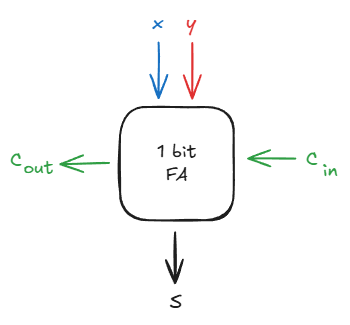
Chaining 1-bit full adders together creates the multi-bit ripple-carry topology below — every carry output C_{n-1} feeds directly into bit n:
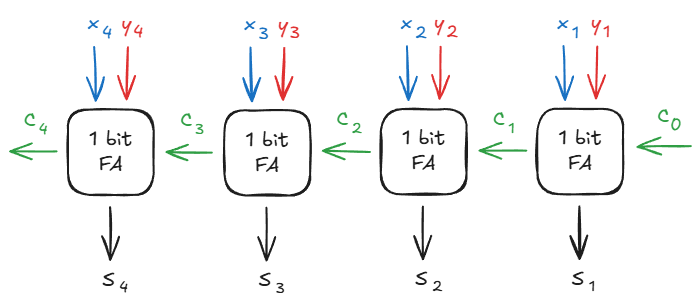
Why can’t we brute-force all swaps? With roughly 220 gates, picking 8 wires out of 220 is 220 choose 8 — tens of trillions of combinations. Instead, look at the structural invariants that every clean ripple-carry full adder obeys:
- Sum and final carry outputs:
S_n = (x_n ^ y_n) ^ C_{n-1}, so everyz_noutput wire (n < max) must come fromXOR, while the final carry-outz_maxmust come fromOR(with bit 0 computed directly asz00 = x00 ^ y00). - Internal
XORplacement: AnyXORgate whose inputs are not directx_n/y_nwires is computingS_n(n > 0), so it must output to az_nwire (!= z00). - Half-sum and intermediate carry fan-out: Both the half-sum
h_n = x_n ^ y_n(n > 0) and every non-final carry wireC_n(ORgate not drivingz_max) have exact consumer set{"XOR", "AND"}. - Carry
ANDfan-out: Both carry termsg_n = x_n & y_nandp_n = h_n & C_{n-1}(n > 0) must have consumer set{"OR"}, whereas bit-0 carryc00 = x00 & y00has consumer set{"XOR", "AND"}.
Checking those four topological rules over the static gate list finds every crossed output wire in O(G) linear time — without simulating a single test vector:
from collections import defaultdict
from dataclasses import dataclass


@dataclass(frozen=True, slots=True)
class Gate:
    """Two-input combinational logic gate."""

    left: str
    op: str
    right: str
    out: str


def find_swapped_adder_wires(gates: list[Gate], highest_z: str) -> list[str]:
    """Flag wires violating 4-rule ripple-carry full-adder topology."""
    consumers: dict[str, set[str]] = defaultdict(set)
    for g in gates:
        consumers[g.left].add(g.op)
        consumers[g.right].add(g.op)

    suspicious: set[str] = set()
    for g in gates:
        inputs = {g.left, g.right}
        is_xy = all(w[0] in ("x", "y") and w[1:].isdigit() for w in inputs)
        is_bit0 = "x00" in inputs and "y00" in inputs

        # Rule 1: z_n outputs must come from XOR, except final carry-out highest_z (from OR).
        expected_z_op = "OR" if g.out == highest_z else "XOR"
        if g.out.startswith("z") and g.op != expected_z_op:
            suspicious.add(g.out)

        # Rule 2: Non-x/y XORs must drive z_n (n > 0); bit-0 XOR(x00, y00) must drive z00.
        if g.op == "XOR" and (
            (not is_xy and (not g.out.startswith("z") or g.out == "z00"))
            or (is_bit0 and g.out != "z00")
        ):
            suspicious.add(g.out)

        # Rule 3: Half-sum XOR(x_n, y_n) (n > 0) and non-final carry OR must feed {XOR, AND}.
        if (
            (g.op == "XOR" and is_xy and not is_bit0)
            or (g.op == "OR" and g.out != highest_z)
        ) and consumers[g.out] != {"XOR", "AND"}:
            suspicious.add(g.out)

        # Rule 4: Bit-0 carry AND feeds {XOR, AND}; all other AND gates must feed {OR}.
        expected_and_consumers = {"XOR", "AND"} if is_bit0 else {"OR"}
        if g.op == "AND" and consumers[g.out] != expected_and_consumers:
            suspicious.add(g.out)

    return sorted(suspicious)


valid_adder_lines = [
    ("x00", "XOR", "y00", "z00"),
    ("x00", "AND", "y00", "c00"),
    ("x01", "XOR", "y01", "h01"),
    ("h01", "XOR", "c00", "z01"),
    ("x01", "AND", "y01", "g01"),
    ("h01", "AND", "c00", "p01"),
    ("g01", "OR", "p01", "c01"),
    ("x02", "XOR", "y02", "h02"),
    ("h02", "XOR", "c01", "z02"),
    ("x02", "AND", "y02", "g02"),
    ("h02", "AND", "c01", "p02"),
    ("g02", "OR", "p02", "z03"),
]
clean_gates = [Gate(l_w, op, r_w, out) for l_w, op, r_w, out in valid_adder_lines]
assert find_swapped_adder_wires(clean_gates, highest_z="z03") == []

for swap_map, expected in (
    ({"z01": "c01", "c01": "z01"}, ["c01", "z01"]),
    ({"h01": "z02", "z02": "h01"}, ["h01", "z02"]),
    ({"g02": "z03", "z03": "g02"}, ["g02", "z03"]),
    ({"c01": "g02", "g02": "c01"}, ["c01", "g02"]),
):
    broken_gates = [Gate(l_w, op, r_w, swap_map.get(out, out)) for l_w, op, r_w, out in valid_adder_lines]
    assert find_swapped_adder_wires(broken_gates, highest_z="z03") == expected
Pair structural rule checking with a quick recursive graph print (or Graphviz plot, as in Dazbo's_Advent_of_Code_2024.ipynb) and hardware faults jump right off the page.
AoC Examples
| Puzzle | Machine / Circuit Style | Key Part 2 Technique | Walkthrough / Code |
|---|---|---|---|
| 2015 Day 7 | 16-bit bitwise logic DAG | Memoised recursive wire evaluation + 0xFFFF mask |
2015 Day 7 |
| 2015 Day 23 | Two-register CPU (hlf/tpl/jio/jie) |
Clean ip dispatch and initial register override |
2015 Day 23 |
| 2016 Day 12 | Assembunny 4-register VM | Register vs immediate arg() resolution |
2016 Day 12 |
| 2016 Day 23 | Self-modifying Assembunny (tgl) |
Runtime peephole multiply-accumulate folding | 2016 Day 23 |
| 2016 Day 25 | Clock-signal Assembunny (out) |
Lazy yield stream + early prefix verification |
2016 Day 25 |
| 2020 Day 8 | Handheld boot console (acc/jmp/nop) |
Visited-state loop detection + single-op patching | 2020 Index / runboot.py |
| 2021 Day 24 | 14-block MONAD ALU (w/x/y/z) |
Decompiling repeating blocks into base-26 stack constraints | 2021 Day 24 |
| 2022 Day 10 | Cycle-accurate CRT CPU (noop/addx) |
Per-tick generator decoupled from sprite rendering | 2022 Day 10 |
| 2024 Day 17 | 3-bit Chronospatial Computer | Backward 3-bit (a << 3) | d DFS decompilation |
2024 Index / 2024 Notebook |
| 2024 Day 24 | Crossed Wires ripple-carry adder | Gate-role structural diagnostics (O(G)) |
2024 Index / 2024 Notebook |