
Page Contents
- When Grid Flood-Fill Breaks
- Unit Squares vs Lattice Vertices
- The Shoelace Formula and Pick’s Theorem
- Point-in-Polygon Scanlines, Ray Casting, and Inscribed Rectangles
- Sides Equal Corners and Manhattan Diamond Geometry
- AoC Examples
When Grid Flood-Fill Breaks
In Part 1 of an Advent of Code grid puzzle, a set of coordinates and a quick collections.deque flood-fill feels effortless. Trace a loop of a few hundred tiles, flood-fill the interior or exterior, call len(), grab your star, and move on.
Then Part 2 scales the coordinates up by six orders of magnitude:
- In
2023 Day 18(Lavaduct Lagoon), the real dig distances come from six-digit hex values. Even the sample lagoon holds 952,408,144,115 cubic metres of lava — nearly a trillion tiles. - In 2025 Day 9 (Movie Theater), red tiles sit on a
100_000 x 100_000tiled floor (10**10cells), yet there are only a few hundred corner vertices.
Trying to allocate a 10**12-tile Grid or set[Point] will swallow every byte of RAM on your machine before you have even finished walking the first trench!
The insight that makes these problems collapse to milliseconds is switching from cells to vertices and edges. Instead of filling every individual square inside a polygon, represent the shape solely by its (V) boundary corners and evaluate area, containment, sides, and distances directly in (O(V)) or (O(V^2)) integer arithmetic.
Unit Squares vs Lattice Vertices
Before jumping into the Shoelace formula, there is a subtle coordinate mismatch that catches almost everyone the first time they apply polygon maths to a discrete grid puzzle.
Suppose a digger carves a 7 x 6 rectangular trench of 1 x 1 unit squares: R 6, D 5, L 6, U 5. How many total tiles are excavated (trench + interior)? Obviously 7 * 6 = 42.
Now pass the centre coordinates (0, 0) -> (6, 0) -> (6, 5) -> (0, 5) straight into the Shoelace formula. What area does it return? 30 (6 * 5), not 42!
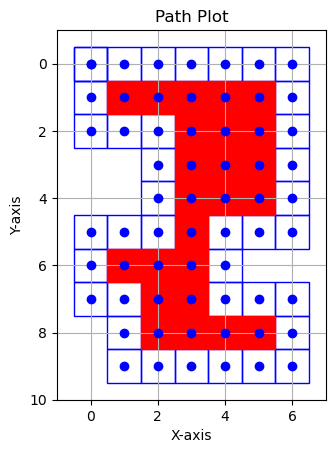
Why are 12 tiles missing from that 7 x 6 rectangle? Look at how each 1 x 1 grid cell sits centred on its lattice point (illustrated above on the 2023 Day 18 sample lagoon), straddling the mathematical polygon boundary:
- Along every straight edge, half of each
1 x 1perimeter cell sticks outside the centreline polygon. - At convex outer corners, three-quarters of the corner cell sticks outside; at concave inner bends, only one-quarter sticks outside.
- Around any closed loop, four more convex bends occur than concave ones — contributing four extra quarter-tiles (
+ 1whole tile!).
Rather than manually pushing every vertex outward by 0.5 units depending on turn direction, keep your clean integer centrelines and combine Shoelace with Pick’s Theorem to recover the missing b // 2 + 1 perimeter contribution in exact integer maths.
The Shoelace Formula and Pick’s Theorem
Given a simple closed polygon with (n) integer vertices ((x_0, y_0), (x_1, y_1), \dots, (x_{n-1}, y_{n-1})) in clockwise or anti-clockwise order (with ((x_n, y_n) = (x_0, y_0))), the Shoelace Formula calculates twice the geometric area as an exact integer:
\[2A = \left| \sum_{k=0}^{n-1} \left( x_k y_{k+1} - x_{k+1} y_k \right) \right|\]Keeping twice_area as a pure Python int right up until the final // 2 avoids floating-point precision loss when coordinates reach (10^{12}) or higher.
Next, Pick’s Theorem connects that geometric area (A) to the number of integer lattice points strictly inside the polygon ((i)) and on its boundary ((b)):
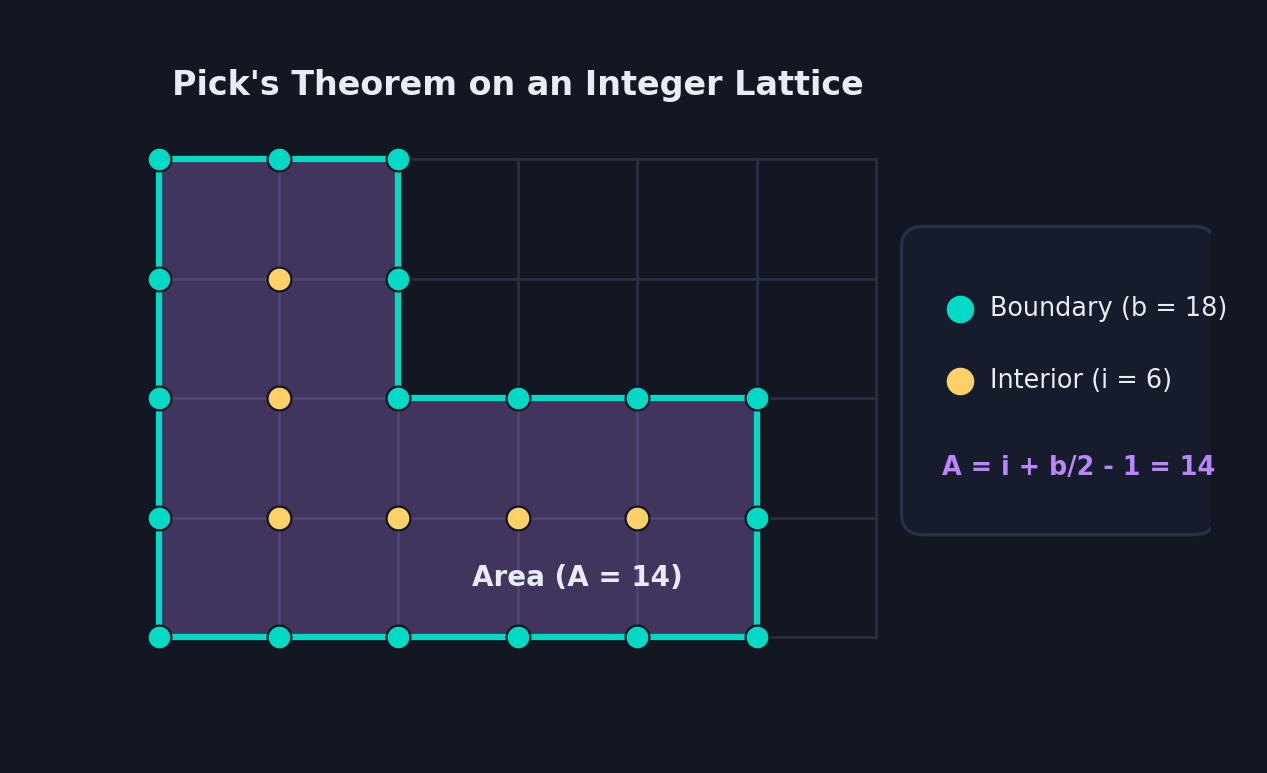
\[A = i + \frac{b}{2} - 1\]Look at the L-shaped lattice diagram above to see Pick’s Theorem in action:
- Geometric area: (A = 14) (
twice_area = 28) - Boundary lattice points: (b = 18)
- Interior lattice points: (i = 6), satisfying (6 + \frac{18}{2} - 1 = 14)
Rearranging Pick’s equation gives us both AoC answers directly in integer arithmetic:
- Strictly interior lattice cells:
(twice_area - boundary_points) // 2 + 1 - Inclusive cells (trench + interior, as in
2023 Day 18):interior + boundary = (twice_area + boundary_points) // 2 + 1
Using itertools.pairwise and math.gcd (which works even for diagonal integer steps, and equals the Manhattan step length along axis-aligned edges), the whole toolkit takes 15 lines of stdlib Python:
import math
from collections.abc import Sequence
from itertools import pairwise


def shoelace_twice_area(vertices: Sequence[tuple[int, int]]) -> int:
    """Return twice the polygon area as an exact integer using itertools.pairwise."""
    if len(vertices) < 3:
        return 0
    closed = [*vertices, vertices[0]]
    cross_sum = sum(x1 * y2 - x2 * y1 for (x1, y1), (x2, y2) in pairwise(closed))
    return abs(cross_sum)


def boundary_lattice_points(vertices: Sequence[tuple[int, int]]) -> int:
    """Count integer lattice points lying on all edges of a lattice polygon."""
    if len(vertices) < 2:
        return len(vertices)
    if len(vertices) == 2:
        (x1, y1), (x2, y2) = vertices
        return math.gcd(abs(x2 - x1), abs(y2 - y1)) + 1
    closed = [*vertices, vertices[0]]
    return sum(math.gcd(abs(x2 - x1), abs(y2 - y1)) for (x1, y1), (x2, y2) in pairwise(closed))


def pick_lattice_counts(vertices: Sequence[tuple[int, int]]) -> tuple[int, int, int]:
    """Return ``(area, interior_points, inclusive_points)`` via Shoelace and Pick's Theorem."""
    twice_area = shoelace_twice_area(vertices)
    if len(vertices) < 3 or twice_area == 0:
        raise ValueError("Pick's Theorem requires a non-degenerate simple polygon (>= 3 vertices)")
    boundary = boundary_lattice_points(vertices)
    interior = (twice_area - boundary) // 2 + 1
    inclusive = (twice_area + boundary) // 2 + 1
    return twice_area // 2, interior, inclusive


# Verify directly against the diagram L-polygon: A = 14, b = 18, i = 6
l_polygon = [(0, 0), (5, 0), (5, 2), (2, 2), (2, 4), (0, 4)]
assert boundary_lattice_points(l_polygon) == 18
assert pick_lattice_counts(l_polygon) == (14, 6, 24)
Applied to the public 2023 Day 18 sample dig plan in /2023/ (see the 2023 notebook), tracking boundary += dist as we trace the orthogonal vertices verifies both Part 1 (62 cells) and the massive Part 2 hex plan (952_408_144_115 cells) in microseconds:
from itertools import pairwise


def lagoon_volume(steps: list[tuple[str, int]]) -> int:
    """Compute inclusive 1x1 cell volume directly from orthogonal dig steps."""
    dirs = {"R": (1, 0), "D": (0, 1), "L": (-1, 0), "U": (0, -1)}
    x = y = boundary = 0
    vertices: list[tuple[int, int]] = [(0, 0)]
    for direction, dist in steps:
        dx, dy = dirs[direction]
        x += dx * dist
        y += dy * dist
        boundary += dist
        vertices.append((x, y))

    twice_area = abs(sum(x1 * y2 - x2 * y1 for (x1, y1), (x2, y2) in pairwise(vertices)))
    return (twice_area + boundary) // 2 + 1


dig_sample = [
    ("R", 6, "#70c710"), ("D", 5, "#0dc571"), ("L", 2, "#5713f0"), ("D", 2, "#d2c081"),
    ("R", 2, "#59c680"), ("D", 2, "#411b91"), ("L", 5, "#8ceee2"), ("U", 2, "#caa173"),
    ("L", 1, "#1b58a2"), ("U", 2, "#caa171"), ("R", 2, "#7807d2"), ("U", 3, "#a77fa3"),
    ("L", 2, "#015232"), ("U", 2, "#7a21e3"),
]
hex_dirs = {"0": "R", "1": "D", "2": "L", "3": "U"}

assert lagoon_volume([(d, n) for d, n, _ in dig_sample]) == 62
assert lagoon_volume([(hex_dirs[h[-1]], int(h[1:-1], 16)) for _, _, h in dig_sample]) == 952408144115
Point-in-Polygon Scanlines, Ray Casting, and Inscribed Rectangles
Sometimes you don’t just need the count of enclosed tiles — you need to ask which specific tiles or which candidate rectangles lie inside a winding, non-convex loop.
Scanline Parity Flipping
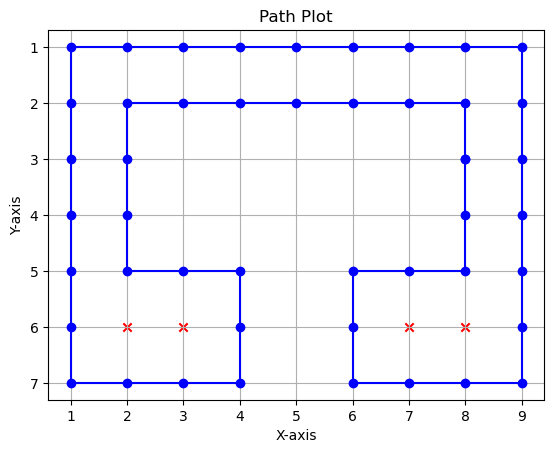
In 2023 Day 10 (Pipe Maze, /2023/), pipes can run shoulder-to-shoulder (||) without leaving an open grid cell between them — yet the space between them still connects to the outside! Naive grid flood-fill treats || as an impenetrable wall unless you double the grid resolution first.
Scanline parity solves this on the original grid in a single (O(H \cdot W)) pass. Walk left-to-right across each row maintaining an inside = False toggle:
- Every vertical wall
|crosses the scanline once and flipsinside = not inside. - Horizontal pipe segments
-never flip parity. - How bends pair up: imagine shifting your horizontal ray a fraction of a tile north of the row centreline (
y - 0.5). Only pipe tiles with an arm pointing north (|,L,J) cross that shifted ray!L---7crosses atLand misses7(1 crossing -> flips parity).F---JmissesFand crosses atJ(1 crossing -> flips parity).L---Jcrosses bothLandJ(2 crossings -> tangent U-turn, parity unchanged).F---7misses both (0 crossings -> tangent U-turn, parity unchanged).
Once you replace the starting S marker with its real pipe symbol, the entire parity rule collapses to ch in {"|", "L", "J"}:
from collections.abc import Sequence


def count_enclosed_scanline(grid_lines: Sequence[str], loop_coords: set[tuple[int, int]]) -> int:
    """Count non-loop tiles enclosed by an orthogonal pipe loop via scanline parity."""
    enclosed = 0
    for y, row in enumerate(grid_lines):
        inside = False
        for x, ch in enumerate(row):
            if (x, y) in loop_coords:
                if ch == "S":
                    raise ValueError("Replace 'S' with its inferred pipe symbol first")
                # Shifting the scanline slightly north crosses '|', 'L', and 'J' once each.
                if ch in {"|", "L", "J"}:
                    inside = not inside
            elif inside:
                enclosed += 1
    return enclosed


pipe_sample = [
    "...........",
    ".F-------7.",
    ".|F-----7|.",
    ".||.....||.",
    ".||.....||.",
    ".|L-7.F-J|.",
    ".|..|.|..|.",
    ".L--J.L--J.",
    "...........",
]
loop_tiles = {(x, y) for y, row in enumerate(pipe_sample) for x, ch in enumerate(row) if ch != "."}
assert count_enclosed_scanline(pipe_sample, loop_tiles) == 4
(Note the important lookup optimisation Dazbo spotted in his notebook: keep loop_coords as a set, never a list — checking (x, y) in loop_coords inside the inner loop drops runtime from minutes to milliseconds.)
Sparse Ray Casting and Inscribed Rectangles
Now scale up again to 2025 Day 9 (Movie Theater) (d09.py). The polygon vertices span a 100_000 x 100_000 floor, so a row-by-row scanline over every cell is out of the question.
Instead, store only the polygon’s vertical and horizontal edges and apply two geometric checks for any candidate rectangle spanned by opposite corners p1 and p2:
- Odd-even ray casting (
is_point_inside): Cast a horizontal ray right from an interior sample point(r_min_x + 0.5, r_min_y + 0.5)and count crossings against vertical edges(vx, y_min, y_max)satisfyingvx > pxandy_min <= py < y_max. Using half-open intervals[y_min, y_max)avoids double-counting shared corners, and adding+ 0.5keeps the probe strictly off integer edges. - Edge-intersection clearance (
rect_strictly_inside_polygon): A non-convex polygon can have dents — a rectangle’s test point might lie inside while a concave bay slices right across the rectangle! Checking that no polygon edge passes strictly inside(r_min_x, r_max_x) x (r_min_y, r_max_y)guarantees the whole rectangle stays inside.
from collections.abc import Sequence
from itertools import combinations, pairwise
from typing import NamedTuple


class Vertex(NamedTuple):
    """Immutable 2D integer vertex."""

    x: int
    y: int


type VerticalEdge = tuple[int, int, int]    # (x, y_min, y_max)
type HorizontalEdge = tuple[int, int, int]  # (x_min, x_max, y)


def extract_orthogonal_edges(
    vertices: Sequence[Vertex],
) -> tuple[list[VerticalEdge], list[HorizontalEdge]]:
    """Split an orthogonal vertex loop into vertical and horizontal axis-aligned edges."""
    vertical: list[VerticalEdge] = []
    horizontal: list[HorizontalEdge] = []
    for p1, p2 in pairwise([*vertices, vertices[0]]):
        if p1.x == p2.x:
            vertical.append((p1.x, min(p1.y, p2.y), max(p1.y, p2.y)))
        elif p1.y == p2.y:
            horizontal.append((min(p1.x, p2.x), max(p1.x, p2.x), p1.y))
        else:
            raise ValueError(f"Non-orthogonal segment from {p1} to {p2}")
    return vertical, horizontal


def is_point_inside(
    px: float,
    py: float,
    vertical_edges: Sequence[VerticalEdge],
) -> bool:
    """Return True if ``(px, py)`` lies inside the polygon using horizontal odd-even ray casting."""
    crossings = 0
    for vx, y_min, y_max in vertical_edges:
        if vx > px and y_min <= py < y_max:
            crossings += 1
    return crossings % 2 == 1


def _point_in_or_on(
    px: float,
    py: float,
    vertical_edges: Sequence[VerticalEdge],
    horizontal_edges: Sequence[HorizontalEdge],
) -> bool:
    """Return True if ``(px, py)`` lies on a boundary edge or strictly inside the polygon."""
    on_edge = any(vx == px and vy1 <= py <= vy2 for vx, vy1, vy2 in vertical_edges) or any(
        hy == py and hx1 <= px <= hx2 for hx1, hx2, hy in horizontal_edges
    )
    return on_edge or is_point_inside(px, py, vertical_edges)


def rect_strictly_inside_polygon(
    p1: Vertex,
    p2: Vertex,
    vertical_edges: Sequence[VerticalEdge],
    horizontal_edges: Sequence[HorizontalEdge],
) -> bool:
    """Return True when the rectangle bounded by ``p1`` and ``p2`` stays inside the polygon."""
    r_min_x, r_max_x = min(p1.x, p2.x), max(p1.x, p2.x)
    r_min_y, r_max_y = min(p1.y, p2.y), max(p1.y, p2.y)

    if r_min_y == r_max_y:
        # Degenerate horizontal strip: split at crossing vertical edges and test all segments.
        xs = sorted({
            r_min_x,
            r_max_x,
            *(vx for vx, vy1, vy2 in vertical_edges if r_min_x < vx < r_max_x and vy1 <= r_min_y <= vy2),
        })
        return all(_point_in_or_on(float(x), float(r_min_y), vertical_edges, horizontal_edges) for x in xs) and all(
            _point_in_or_on((x1 + x2) / 2, float(r_min_y), vertical_edges, horizontal_edges)
            for x1, x2 in pairwise(xs)
        )

    if r_min_x == r_max_x:
        # Degenerate vertical strip: split at crossing horizontal edges and test all segments.
        ys = sorted({
            r_min_y,
            r_max_y,
            *(hy for hx1, hx2, hy in horizontal_edges if r_min_y < hy < r_max_y and hx1 <= r_min_x <= hx2),
        })
        return all(_point_in_or_on(float(r_min_x), float(y), vertical_edges, horizontal_edges) for y in ys) and all(
            _point_in_or_on(float(r_min_x), (y1 + y2) / 2, vertical_edges, horizontal_edges)
            for y1, y2 in pairwise(ys)
        )

    if not is_point_inside(r_min_x + 0.5, r_min_y + 0.5, vertical_edges):
        return False

    # Reject if any polygon boundary cuts through the rectangle's strict interior.
    for vx, vy_min, vy_max in vertical_edges:
        if r_min_x < vx < r_max_x and max(vy_min, r_min_y) < min(vy_max, r_max_y):
            return False
    for hx_min, hx_max, hy in horizontal_edges:
        if r_min_y < hy < r_max_y and max(hx_min, r_min_x) < min(hx_max, r_max_x):
            return False

    return True


red_tiles = [
    Vertex(7, 1), Vertex(11, 1), Vertex(11, 7), Vertex(9, 7),
    Vertex(9, 5), Vertex(2, 5), Vertex(2, 3), Vertex(7, 3),
]
v_edges, h_edges = extract_orthogonal_edges(red_tiles)
max_area = max(
    (abs(a.x - b.x) + 1) * (abs(a.y - b.y) + 1)
    for a, b in combinations(red_tiles, 2)
    if rect_strictly_inside_polygon(a, b, v_edges, h_edges)
)
assert max_area == 24

# Degenerate 1-tile strip across a U-shaped concavity must be rejected
u_poly = [
    Vertex(0, 0), Vertex(10, 0), Vertex(10, 6), Vertex(9, 6),
    Vertex(9, 2), Vertex(7, 2), Vertex(7, 6), Vertex(0, 6),
]
u_v, u_h = extract_orthogonal_edges(u_poly)
assert not rect_strictly_inside_polygon(Vertex(0, 6), Vertex(10, 6), u_v, u_h)
assert rect_strictly_inside_polygon(Vertex(0, 6), Vertex(7, 6), u_v, u_h)
Sides Equal Corners and Manhattan Diamond Geometry
Two final geometric identities show up again and again across Advent of Code — turning fiddly edge-tracing into tiny, elegant functions.
Counting Polygon Sides via 2x2 Corners
In 2024 Day 12 (Garden Groups, /2024/), Part 2 prices each connected crop region by area * number_of_sides, where an entire straight fence run counts as one side.
My first working solution tracked four directional perimeter sets (N, E, S, W) and ran a separate BFS flood-fill inside each set to count contiguous straight edges. It works, sure — until you step back and remember a fundamental property of closed polygons:
Every closed polygon (including regions with internal holes!) has the exact same number of straight sides as it has corners.
And you can count every corner of a 4-connected region: set[tuple[int, int]] locally around each cell (x, y) by checking its four 2 x 2 corner triplets (orthogonal_1, orthogonal_2, diagonal):
- Outer (convex) corner: Neither
orthogonal_1nororthogonal_2belongs toregion. (For a single isolated1 x 1plot, all four corners trigger — giving4sides automatically.) - Inner (concave) corner: Both
orthogonal_1andorthogonal_2belong toregion, but thediagonalcell between them does not!
from collections import deque

_CORNER_OFFSETS: tuple[tuple[tuple[int, int], tuple[int, int], tuple[int, int]], ...] = (
    ((0, -1), (-1, 0), (-1, -1)),  # North-West
    ((0, -1), (1, 0), (1, -1)),    # North-East
    ((0, 1), (-1, 0), (-1, 1)),    # South-West
    ((0, 1), (1, 0), (1, 1)),      # South-East
)


def count_polygon_corners(region: set[tuple[int, int]]) -> int:
    """Count straight polygon sides of a 4-connected grid region via 2x2 corners."""
    corners = 0
    for x, y in region:
        for (dx1, dy1), (dx2, dy2), (dxd, dyd) in _CORNER_OFFSETS:
            in_n1 = (x + dx1, y + dy1) in region
            in_n2 = (x + dx2, y + dy2) in region
            in_diag = (x + dxd, y + dyd) in region
            if (not in_n1 and not in_n2) or (in_n1 and in_n2 and not in_diag):
                corners += 1
    return corners


# Verify on the 2024 Day 12 10x10 sample map -> 1206
garden_sample = [
    "RRRRIICCFF", "RRRRIICCCF", "VVRRRCCFFF", "VVRCCCJFFF", "VVVVCJJCFE",
    "VVIVCCJJEE", "VVIIICJJEE", "MIIIIIJJEE", "MIIISIJEEE", "MMMISSJEEE",
]
rows, cols = len(garden_sample), len(garden_sample[0])
visited: set[tuple[int, int]] = set()
bulk_price = 0

for y in range(rows):
    for x in range(cols):
        if (x, y) in visited:
            continue
        crop = garden_sample[y][x]
        region: set[tuple[int, int]] = {(x, y)}
        queue: deque[tuple[int, int]] = deque([(x, y)])
        visited.add((x, y))
        while queue:
            cx, cy = queue.popleft()
            for dx, dy in ((1, 0), (-1, 0), (0, 1), (0, -1)):
                nx, ny = cx + dx, cy + dy
                if 0 <= nx < cols and 0 <= ny < rows and (nx, ny) not in visited and garden_sample[ny][nx] == crop:
                    visited.add((nx, ny))
                    region.add((nx, ny))
                    queue.append((nx, ny))
        bulk_price += len(region) * count_polygon_corners(region)

assert bulk_price == 1206
Not bad for 11 lines of corner arithmetic, right?
Manhattan Voronoi Regions and 45-Degree Chebyshev Rotation
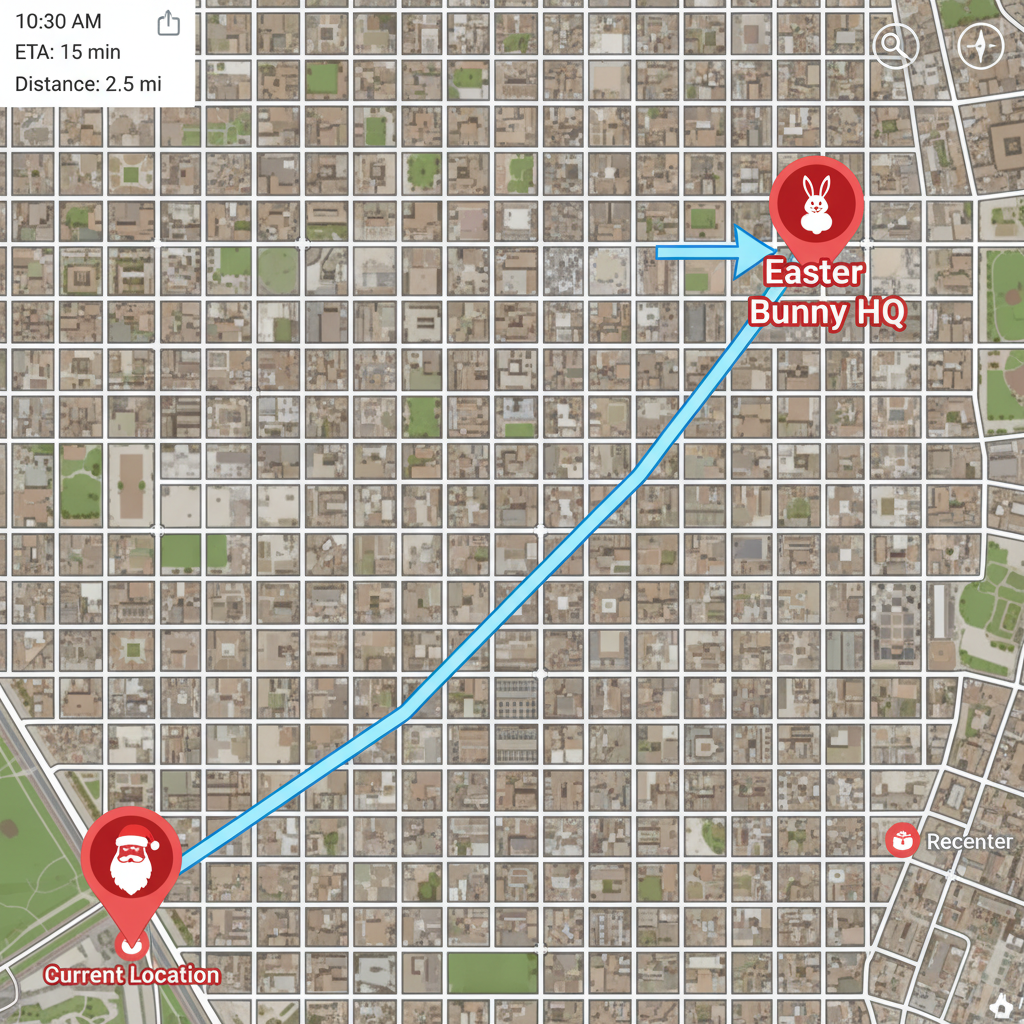
On orthogonal city-block grids, shortest distance isn’t a straight Euclidean crow-fly line — it is Manhattan ((L_1)) distance (|x1 - x2| + |y1 - y2|, built right into aoc_common.Point.manhattan_distance_from).
In 2018 Day 6 (Chronal Coordinates) (d06.py), we partition the grid into Manhattan Voronoi regions by assigning every coordinate to its unique closest seed. How do you know which seeds expand infinitely without searching forever?
Just check aoc_common.bounding_box(seeds): any seed whose closest-point region touches the bounding box edge (x in (tl.x, br.x) or y in (tl.y, br.y)) extends to infinity, because stepping straight outward away from the box adds 1 to the distance from every seed equally — so whichever seed is closest on the border stays closest forever:
from collections import Counter
from collections.abc import Sequence

from aoc_common import Point, bounding_box


def largest_finite_voronoi_area(seeds: Sequence[Point]) -> int:
    """Find the largest finite Manhattan Voronoi area inside the seeds' bounding box."""
    tl, br = bounding_box(seeds)
    areas: Counter[Point] = Counter()
    infinite: set[Point] = set()

    for y in range(tl.y, br.y + 1):
        for x in range(tl.x, br.x + 1):
            cell = Point(x, y)
            dists = [(cell.manhattan_distance_from(seed), seed) for seed in seeds]
            min_dist = min(dist for dist, _ in dists)
            nearest = [seed for dist, seed in dists if dist == min_dist]
            if len(nearest) == 1:
                owner = nearest[0]
                areas[owner] += 1
                if x in (tl.x, br.x) or y in (tl.y, br.y):
                    infinite.add(owner)

    return max((area for seed, area in areas.items() if seed not in infinite), default=0)


sample_seeds = [Point(1, 1), Point(1, 6), Point(8, 3), Point(3, 4), Point(5, 5), Point(8, 9)]
assert largest_finite_voronoi_area(sample_seeds) == 17
And here is one last Manhattan trick worth keeping in your back pocket: the (45^\circ) Chebyshev Rotation.
All points within Manhattan distance (r) of a sensor form a tilted (45^\circ) diamond, which is awkward to intersect or bound. Transform every (x, y) coordinate into (u, v) = (x + y, x - y):
Under that rotation, every tilted Manhattan diamond of radius (r) becomes an ordinary axis-aligned Chebyshev ((L_\infty)) square of half-width (r)! That immediately turns intersection of sensor diamonds into plain interval overlap — and finds the maximum pairwise Manhattan distance across (N) points in (O(N)) linear time instead of (O(N^2)):
from collections.abc import Sequence


def to_chebyshev(x: int, y: int) -> tuple[int, int]:
    """Rotate Manhattan coordinates 45 degrees so L1 diamonds become axis-aligned squares."""
    return (x + y, x - y)


def max_manhattan_distance(points: Sequence[tuple[int, int]]) -> int:
    """Compute maximum pairwise Manhattan distance in O(n) via Chebyshev rotation."""
    if len(points) < 2:
        return 0
    rotated = [to_chebyshev(x, y) for x, y in points]
    us = [u for u, _ in rotated]
    vs = [v for _, v in rotated]
    return max(max(us) - min(us), max(vs) - min(vs))


pts = [(1, 1), (1, 6), (8, 3), (3, 4), (5, 5), (8, 9)]
assert max_manhattan_distance(pts) == 15
AoC Examples
| Puzzle | Technique | Link / Source |
|---|---|---|
| 2018 Day 6 — Chronal Coordinates | Manhattan Voronoi regions & bounding-box infinity detection | Walkthrough / d06.py |
| 2023 Day 10 — Pipe Maze | Scanline parity (| vs L/J bends) & enclosed-tile counting |
2023 Index / Notebook |
| 2023 Day 18 — Lavaduct Lagoon | Integer Shoelace + Pick’s Theorem for (9.5 \times 10^{11}+) areas | 2023 Index / Notebook |
| 2024 Day 12 — Garden Groups | Counting straight polygon sides via 2x2 corners | 2024 Index / Notebook |
| 2025 Day 9 — Movie Theater | Sparse odd-even ray casting & inscribed rectangle intersection checks | Walkthrough / d09.py |