
Page Contents
- Why Modern Idioms Pay Off Under Time Pressure
- Structural Pattern Matching (
match/case) - PEP 695 Type Statements, Generics, and
typing.Self - Immutable State Modelling:
tuplevsNamedTuplevs Frozen Dataclass - Underused Standard Library Gems
- AoC Examples
Why Modern Idioms Pay Off Under Time Pressure
Halfway through a tough Advent of Code Part 2, bugs rarely come from exotic computer science — they come from sloppy boilerplate. A tangle of if tokens[0] == ... elif len(tokens) == 3: branches hides an inverted index. A mutable [x, y] coordinate gets passed into @cache or mutated in place inside a BFS frontier. Thirty lines of hand-rolled Kahn’s algorithm introduce an off-by-one in-degree bug on a 10-line dependency parser.
Modern Python (3.10 through 3.13+) eliminates whole categories of those paper cuts without external libraries. This page assumes you already know foundational OOP from Classes and Objects and core combinatorics from Permutations, Combinations, Products and More, and focuses instead on the ergonomics and underused standard library gems that make puzzle code shorter, safer, and far easier to debug.
Structural Pattern Matching (match / case)
Sequence, Tuple, Class, and Guard Patterns
Introduced in Python 3.10, match / case goes well beyond a C-style switch statement, checking structure and unpacking values in one visual pass. Across recent puzzles — from cube-face transitions in 2022 Day 22 and operator evaluation in 2025 Day 6 (d06.py) to VM instructions, pipe mazes, and logic gates across the 2023 Notebook and 2024 Notebook — four matching shapes come up constantly:
- Sequence unpacking (
["set", reg, val]or[op, *rest]): match command names, arity, and bound operands in one step. - OR patterns and
asbindings ("add" | "mul" as op): collapse symmetric instruction variants without duplicating logic. - Tuple coordinate dispatch (
match (tile, dx, dy):): route pipe turns and directional transitions cleanly (2023 Day 10). - Class attribute destructuring and
ifguards: match fields inside dataclasses (e.g.2024 Day 24-style logic gates) or branch on computed properties like digit parity (2024 Day 11).
Here are those patterns working together on self-contained AoC-style helpers:
from dataclasses import dataclass


class Bounds:
    """Namespace constants for dotted pattern matching."""

    WIDTH = 10


@dataclass(frozen=True, slots=True)
class Gate:
    """Logic gate node matching 2024 Day 24 style expressions."""

    op: str
    left: str
    right: str


def eval_instruction(tokens: list[str], registers: dict[str, int]) -> int:
    """Demonstrate sequence unpacking, OR patterns, and dotted constants."""
    match tokens:
        case ["set", reg, val]:
            registers[reg] = int(val)
            return registers[reg]
        case ["add" | "mul" as op, reg, rhs]:
            val = registers[rhs] if rhs in registers else int(rhs)
            registers[reg] = registers[reg] + val if op == "add" else registers[reg] * val
            return registers[reg]
        case ["clamp", val] if int(val) >= Bounds.WIDTH:
            return Bounds.WIDTH
        case ["clamp", val]:
            return int(val)
        case [op, *args]:
            raise ValueError(f"Unsupported instruction {op!r} with args {args!r}")
        case _:
            raise ValueError("Empty instruction")


def step_pipe(tile: str, heading: tuple[int, int]) -> tuple[int, int] | None:
    """Route a 2D movement vector through pipe bends (2023 Day 10 style)."""
    match (tile, heading):
        case ("|", (0, _)) | ("-", (_, 0)):
            return heading
        case ("L", (0, 1)) | ("F", (0, -1)):
            return (1, 0)
        case ("L", (-1, 0)) | ("J", (1, 0)):
            return (0, -1)
        case ("7", (1, 0)) | ("F", (-1, 0)):
            return (0, 1)
        case ("J", (0, 1)) | ("7", (0, -1)):
            return (-1, 0)
        case _:
            return None


def blink_stone(stone: int) -> list[int]:
    """Demonstrate guard patterns on integers (2024 Day 11 style)."""
    match stone:
        case 0:
            return [1]
        case x if len(str(x)) % 2 == 0:
            digits = str(x)
            mid = len(digits) // 2
            return [int(digits[:mid]), int(digits[mid:])]
        case _:
            return [stone * 2024]


def describe_gate(gate: Gate) -> str:
    """Demonstrate symmetric class attribute destructuring."""
    match gate:
        case Gate(op="XOR", left="x00", right=r) | Gate(op="XOR", left=r, right="x00"):
            return f"Half-adder sum bit paired with {r}"
        case Gate(op=op, left=left, right=right):
            return f"{left} {op} {right}"


regs = {"a": 2}
assert eval_instruction(["add", "a", "5"], regs) == 7
assert eval_instruction(["mul", "a", "a"], regs) == 49
assert eval_instruction(["clamp", "42"], regs) == 10
assert step_pipe("-", (1, 0)) == (1, 0)
assert step_pipe("L", (0, 1)) == (1, 0)
assert blink_stone(0) == [1]
assert blink_stone(1000) == [10, 0]
assert blink_stone(17) == [1, 7]
assert blink_stone(125) == [253000]
assert describe_gate(Gate("XOR", "y00", "x00")) == "Half-adder sum bit paired with y00"
Watching Out for Bare-Name Capture
There is one subtle gotcha that catches almost everyone the first time they write match / case. A bare identifier like case WIDTH: is always treated as a variable capture, not a value comparison against an existing variable named WIDTH. Put case WIDTH: ahead of other branches and Python raises a SyntaxError (name capture 'WIDTH' makes remaining patterns unreachable); put it as your final branch and it silently overwrites WIDTH with whatever value was matched!
Whenever you want match to compare against a named constant by value, qualify it with a dot — either a small namespace class (Bounds.WIDTH, as shown above) or an Enum member (Direction.NORTH). In Python’s pattern grammar, a dotted name (a.b) is always a value lookup, never a capture target.
PEP 695 Type Statements, Generics, and typing.Self
Python 3.12+ (PEP 695) finally retires the awkward T = TypeVar("T") preamble when writing generic puzzle utilities. Combined with PEP 585 built-in generics (list[int], dict[str, int]), PEP 604 unions (T | None), and Python 3.11’s typing.Self, type hints become readable documentation instead of visual clutter:
type Alias = ...: lazily evaluated type aliases cleanly name grid positions (GridPos) or generic adjacency maps (AdjList[T]).def fn[T](...): declares type parameters inline right after the function name.typing.Self: tellspyrightthat an immutable method like.translate()returns an instance of whichever subclass called it, avoiding redundant casts if you subclassPoint.
from collections.abc import Iterable
from dataclasses import dataclass
from typing import Self

type GridPos = tuple[int, int]
type AdjList[T] = dict[T, set[T]]


def first_duplicate[T](items: Iterable[T]) -> T | None:
    """Return the first repeated element in an iterable, or None if all are unique."""
    seen: set[T] = set()
    for item in items:
        if item in seen:
            return item
        seen.add(item)
    return None


@dataclass(frozen=True, order=True, slots=True)
class Point:
    """Immutable, hashable, heap-sortable 2D coordinate using typing.Self."""

    x: int
    y: int

    def translate(self, dx: int, dy: int) -> Self:
        """Return a shifted coordinate of the same concrete class."""
        return type(self)(self.x + dx, self.y + dy)


assert first_duplicate([3, 1, 4, 1, 5]) == 1
assert first_duplicate(["a", "b", "c"]) is None
assert Point(2, 3).translate(-1, 1) == Point(1, 4)
Notice we never import deprecated List, Dict, Optional, Tuple, or Union from typing — lowercase built-ins and | unions work everywhere from Python 3.10 onwards (with PEP 695 syntax requiring 3.12+).
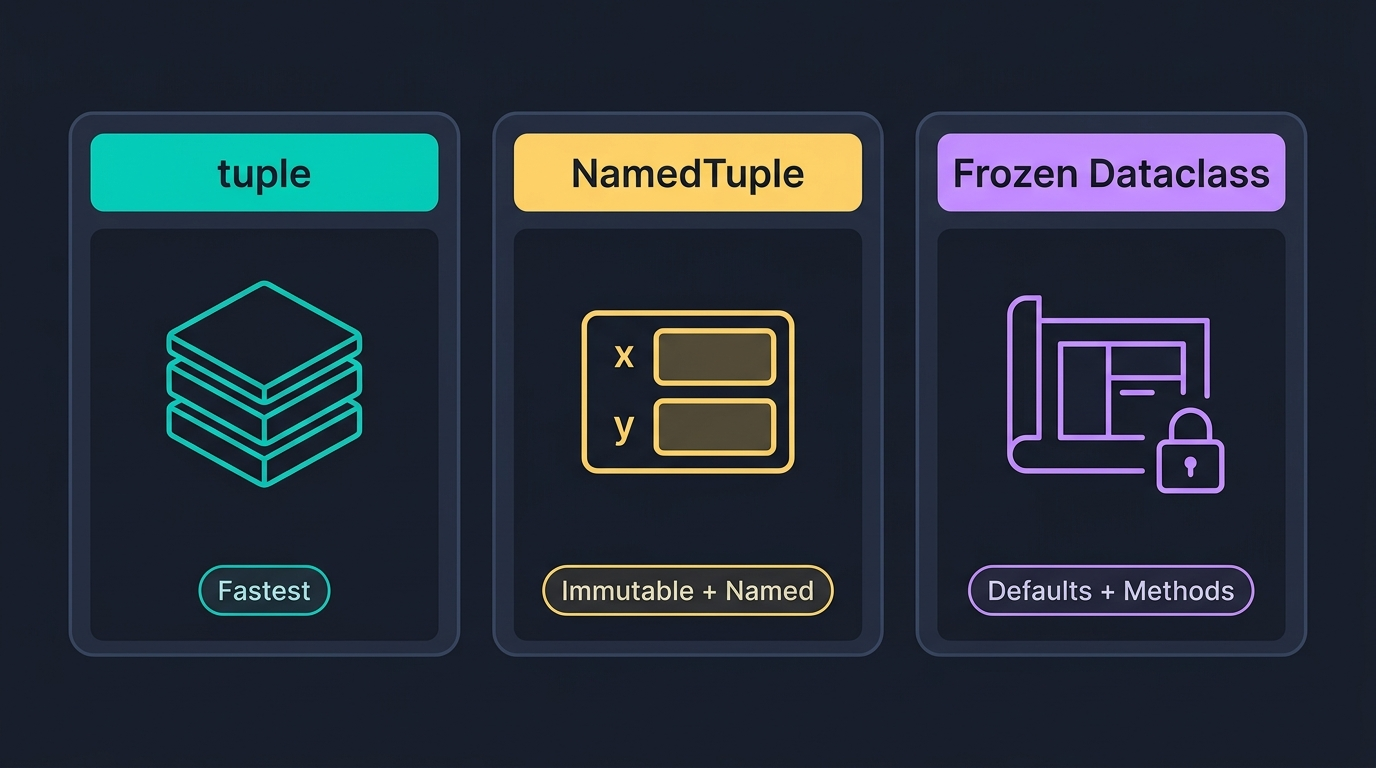
Immutable State Modelling: tuple vs NamedTuple vs Frozen Dataclass
In grid searches, DP memoisation (@cache), and Dijkstra priority queues, choosing the right immutable state type affects both bug count and inner-loop speed:
| Feature | Plain tuple |
NamedTuple |
@dataclass(frozen=True, slots=True) |
|---|---|---|---|
| Attribute readability | None (pos[0], pos[1]) |
Good (box.x, box.y, box.z) |
Excellent (point.x, point.y) |
| Unpacking support | Native (x, y = pos) |
Native (x, y, z = box) |
No (explicit field access only) |
| Heap sortability | Native element-wise | Native element-wise | Needs order=True |
@cache / set hashing |
Fastest (C tuple hash) | Nearly as fast as tuple |
Fast with slots=True, slightly slower field hash |
Defaults & kw_only |
None | Trailing defaults only | Full defaults, default_factory, kw_only=True |
| Custom methods / isolation | None | Supports methods, but Box(1, 2, 3) == (1, 2, 3) |
Supports __add__ / properties; type-distinct (Point(1, 2) != (1, 2)) |
Notice the progression across this repository: early 2D grids often used raw (x, y) tuples or complex numbers (Complex Numbers), aoc_common.Point uses @dataclass(frozen=True, order=True, slots=True) with custom arithmetic, and in 2025 Day 7 (d07.py) and 2025 Day 8 (d08.py), lightweight NamedTuple types (Point, Box) give you named attributes and zero-overhead tuple unpacking/hashing.
One rule of thumb for Dijkstra queues: whenever two states tie on priority (cost, state), heapq falls back to comparing state < other_state. A NamedTuple gets lexicographic ordering for free; a frozen dataclass must pass order=True or heapq.heappush will crash with TypeError: '<' not supported between instances the moment a tie occurs:
import heapq
from dataclasses import dataclass
from functools import cache
from typing import NamedTuple, Self


@dataclass(frozen=True, order=True, slots=True)
class Point:
    """Hashable and heap-sortable 2D coordinate."""

    x: int
    y: int

    def translate(self, dx: int, dy: int) -> Self:
        """Return a shifted coordinate."""
        return type(self)(self.x + dx, self.y + dy)


class Box(NamedTuple):
    """3D coordinate with named fields and tuple speed (2025 Day 8 style)."""

    x: int
    y: int
    z: int

    def shifted(self, dx: int, dy: int, dz: int) -> Self:
        """Return a translated 3D junction box."""
        return type(self)(self.x + dx, self.y + dy, self.z + dz)


@cache
def manhattan_steps(start: Point, goal: Point) -> int:
    """Cached distance helper proving frozen slotted dataclasses are hashable."""
    return abs(goal.x - start.x) + abs(goal.y - start.y)


# Equal distance (5) forces heapq to break ties using Point's order=True comparison
pq: list[tuple[int, Point]] = []
p1 = Point(2, 3)
p2 = p1.translate(-1, 1)  # Point(1, 4), also distance 5 from origin
heapq.heappush(pq, (manhattan_steps(Point(0, 0), p1), p1))
heapq.heappush(pq, (manhattan_steps(Point(0, 0), p2), p2))
assert heapq.heappop(pq) == (5, Point(1, 4))
assert heapq.heappop(pq) == (5, Point(2, 3))

box = Box(162, 817, 812)
assert box.x == 162 and box[0] == 162
(Watch out if you mix raw tuples and NamedTuple keys inside the same set or dict: because NamedTuple subclasses tuple, Box(1, 2, 3) == (1, 2, 3) evaluates to True, whereas Point(1, 2) == (1, 2) is False.)
Underused Standard Library Gems
itertools Pipeline Helpers Beyond Combinatorics
Permutations, Combinations, Products and More already covers product, permutations, combinations, chain, and cycle. Beyond combinatorics, five itertools helpers replace index-heavy for i in range(len(xs) - 1) loops across AoC:
itertools.pairwise(3.10+): yields overlapping adjacent pairs(a, b)— ideal for checking step differences in2024 Day 2without worrying about off-by-one bounds.itertools.batched(..., strict=True)(3.12+, withstrict=Trueadded in 3.13): slices flat integer lists into fixed chunks like(start, length)seed pairs in2023 Day 5. Passingstrict=Truefails loudly if an input line ever has a trailing orphan token.itertools.accumulate: emits running totals or running coordinates without manually maintaining an accumulator variable.itertools.groupby: collapses consecutive equal items — classic for Look-and-Say sequences in 2015 Day 10. Just remembergroupbyonly merges adjacent matching keys, so sort first if you want global grouping.itertools.starmap: unpacks each tuple in an iterable directly into positional arguments (starmap(Point, pairs)).
import operator
from itertools import accumulate, batched, groupby, pairwise, starmap
from typing import NamedTuple


class Coord(NamedTuple):
    """Simple 2D coordinate for starmap unpacking."""

    x: int
    y: int


def is_safe_report(levels: list[int], max_step: int = 3) -> bool:
    """Check monotonic bounded steps using itertools.pairwise (2024 Day 2 style)."""
    diffs = [b - a for a, b in pairwise(levels)]
    return all(1 <= d <= max_step for d in diffs) or all(-max_step <= d <= -1 for d in diffs)


def look_and_say(seq: str) -> str:
    """Compute one Look-and-Say iteration using itertools.groupby (2015 Day 10 style)."""
    return "".join(f"{len(list(group))}{digit}" for digit, group in groupby(seq))


assert is_safe_report([7, 6, 4, 2, 1]) is True
assert is_safe_report([1, 2, 7, 8, 9]) is False

seed_ranges = list(batched([79, 14, 55, 13], 2, strict=True))
assert seed_ranges == [(79, 14), (55, 13)]
assert list(starmap(Coord, seed_ranges)) == [Coord(79, 14), Coord(55, 13)]
assert list(accumulate([3, 1, 4, 2], operator.add)) == [3, 4, 8, 10]

seq = "1"
for _ in range(4):
    seq = look_and_say(seq)
assert seq == "111221"
collections.Counter Multiset Algebra
Most people reach for Counter just to tally frequencies and call .most_common(). Under the bonnet, Counter also supports full multiset algebra — and since Python 3.10, .total() sums all counts cleanly in one call:
a + b: add frequencies.a - b: subtract counts and automatically drop zero or negative keys (ideal when tracking remaining inventory or polymer pair steps).a & b: intersection (element-wise minimum of positive counts).a | b: union (element-wise maximum of positive counts).
from collections import Counter

stock = Counter({"fuel": 5, "ore": 8})
used = Counter({"fuel": 2, "ore": 10})

assert stock - used == Counter({"fuel": 3})  # 'ore' dropped automatically at <= 0
assert (stock & used) == Counter({"fuel": 2, "ore": 8})
assert (stock | used).total() == 15
graphlib.TopologicalSorter for Dependency DAGs
Whenever a puzzle says “item A must appear before item B” (2024 Day 5 Print Queue) or tracks which bricks support which other bricks above them (2023 Day 22 Sand Slabs), resist the urge to hand-roll Kahn’s algorithm with two dicts and a deque. graphlib.TopologicalSorter lives in the standard library:
- Call
sorter.add(node, *predecessors)to declare dependencies (careful: the target node comes first, followed by everything that must come before it!). - Call
list(sorter.static_order())to obtain a valid linear ordering, or catchgraphlib.CycleErrorif a contradiction creates a cycle.
from graphlib import CycleError, TopologicalSorter


def fix_page_order(pages: list[int], rules: list[tuple[int, int]]) -> list[int]:
    """Topologically sort pages respecting ``before|after`` rules (2024 Day 5 style)."""
    page_set = set(pages)
    sorter: TopologicalSorter[int] = TopologicalSorter()
    for page in pages:
        sorter.add(page)
    for before, after in rules:
        if before in page_set and after in page_set:
            sorter.add(after, before)  # 'after' depends on 'before'
    return list(sorter.static_order())


sample_rules = [
    (47, 53), (97, 13), (97, 61), (97, 47), (75, 29), (61, 13), (75, 53),
    (29, 13), (97, 29), (53, 29), (61, 53), (97, 53), (61, 29), (47, 13),
    (75, 47), (97, 75), (47, 61), (75, 61), (47, 29), (75, 13), (53, 13),
]
assert fix_page_order([75, 97, 47, 61, 53], sample_rules) == [97, 75, 47, 61, 53]

cyclic: TopologicalSorter[str] = TopologicalSorter({"A": {"B"}, "B": {"A"}})
try:
    list(cyclic.static_order())
    raise AssertionError("Expected CycleError")
except CycleError:
    pass
Small Daily Ergonomics
Finally, five tiny built-ins clean up everyday parsing and bitwork lines (pairs nicely with Regular Expressions and Comprehensions):
- Walrus
:=in line-parsing comprehensions: match a compiled regex and immediately extract groups without running.match()twice. int.bit_count()(3.10+): hardware-fast popcount without allocating a string viabin(n).count("1").math.prod(): multiplies an iterable in C instead offunctools.reduce(operator.mul, ...).str.removeprefix()/str.removesuffix(): unlike.lstrip("Button A: ")— which famously strips individual characters rather than a whole prefix string —removeprefixmatches the exact substring.next((...), None)+any()/all(): short-circuits cleanly on the first match without materialising an intermediate list.
import math
import re

pattern = re.compile(r"mul\((\d+),(\d+)\)")
lines = ["noop", "mul(6,7)", "end"]

products = [int(m.group(1)) * int(m.group(2)) for line in lines if (m := pattern.match(line))]
assert products == [42]

assert (0b101101).bit_count() == 4
assert math.prod([123, 45, 6]) == 33210
assert "Button A: X+94".removeprefix("Button A: ") == "X+94"
assert next((n for n in [3, 5, 8, 10] if n % 2 == 0), None) == 8
AoC Examples
| Puzzle | Applicable Modern Idiom | Solution Link |
|---|---|---|
| 2015 Day 10 — Elves Look, Elves Say | itertools.groupby run-length encoding |
2015 Day 10 |
| 2022 Day 22 — Monkey Map | match / case cube-face wrapping |
2022 Day 22 |
| 2023 Day 5, 7, 10, 20, 22 | batched, match/case card hands & pipes, TopologicalSorter DAGs |
2023 Notebook (2023 Hub) |
| 2024 Day 2, 5, 7, 11, 17, 24 | pairwise, TopologicalSorter, match/case stone parity & logic gates |
2024 Notebook (2024 Hub) |
| 2025 Day 6 — Trash Compactor | match / case operator dispatch + math.prod |
2025 Day 6 (d06.py) |
| 2025 Day 7 & 8 — Laboratories & Playground | Immutable NamedTuple Point and Box state modelling |
2025 Day 7 (d07.py), 2025 Day 8 (d08.py) |
Shared Utilities (aoc_common) |
Frozen slotted @dataclass Point, PEP 585/604 annotations |
aoc_commons.py |