
Page Contents
- Jumping Across a Trillion Iterations
- Cycle Detection via State Hashing
- Synchronising Independent Cycles with
math.lcm - Modular Ring Wrapping, LCM Modulus, and Modular Inverses
- The Chinese Remainder Theorem
- AoC Examples
Jumping Across a Trillion Iterations
Here is a familiar Advent of Code story. Part 1 asks you to run a clean little simulation for 20 rounds, 100 seconds, or 2,022 falling rocks. Your naive loop finishes in 10 milliseconds, prints the right answer, and you feel like an absolute hero.
Then you unlock Part 2:
“Do the exact same thing
1_000_000_000times.” Or1_000_000_000_000times. Or wait until six parallel walkers collide at step ( 10^{13} ).
If you just change 2022 to 1_000_000_000_000 and hit run, you are not watching a fast algorithm anymore — you are watching your terminal sit blank half an hour later while a single CPU core melts. (Ask me how I know — my first brute-force attempt on 2023 Day 8 was still chugging 30 minutes later before I finally hit Ctrl+C.)
The insight that shatters Part 2 scale is the Pigeonhole Principle. Whenever a simulation is deterministic (the next state depends only on the current state) and operates over a finite state space of size ( N ), it cannot produce new states forever. By step ( N + 1 ) at the absolute latest, it must revisit a state it has already seen. From that moment onward, every subsequent transition is locked into a repeating loop forever.
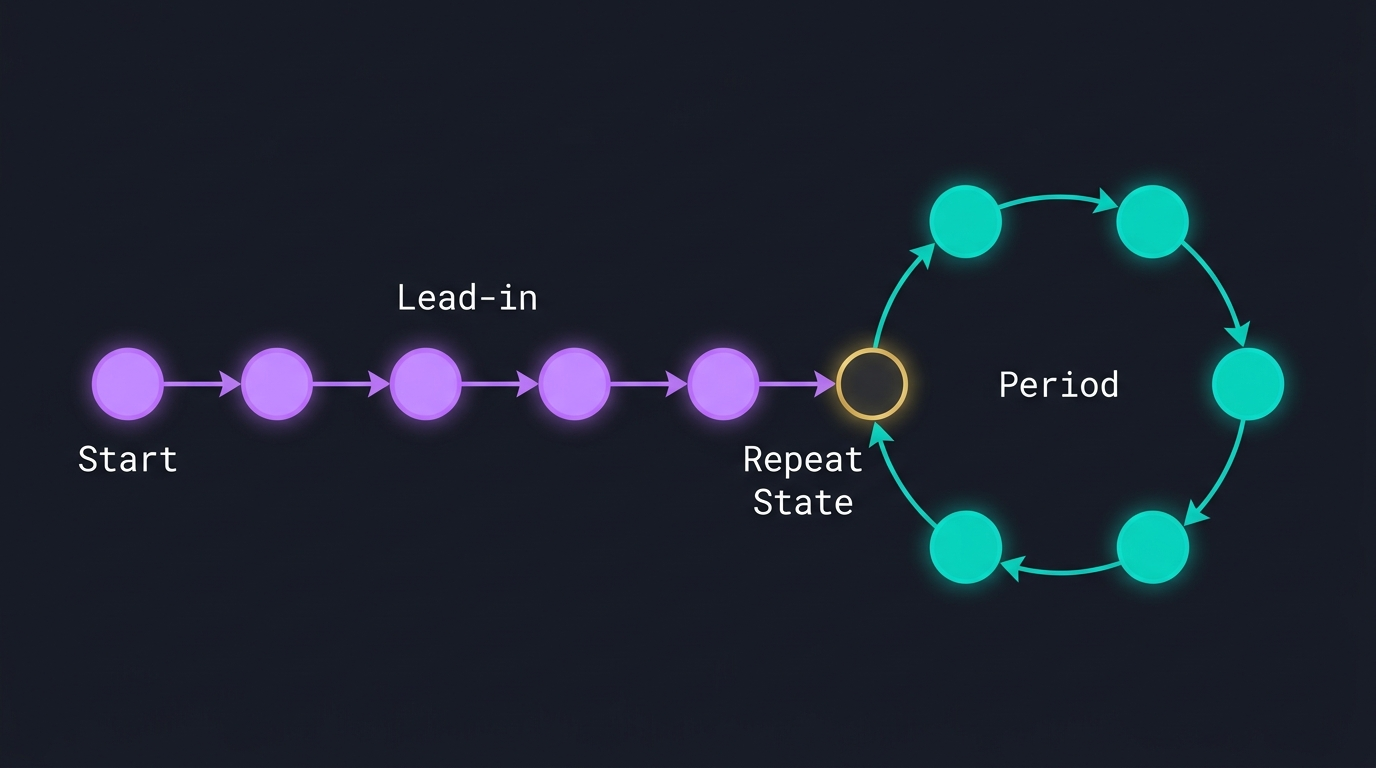
Notice the classic “rho” ((\rho)) shape in the diagram above. Every deterministic finite system splits neatly into two phases:
- A lead-in (transient tail) of length (\mu) steps before the system first touches its eventual cycle.
- A repeating cycle of period (P = t - \mu), starting the first time a state repeats at step (t).
Once you catch that first repeat, simulating a trillion steps is pointless. Any target step (T \ge \mu) maps straight onto an already-visited step inside the first cycle using remainder arithmetic:
\[T_{\text{equiv}} = \mu + ((T - \mu) \bmod P)\]Instead of running (10^{12}) iterations, you simulate (\mu + P) iterations and jump across the rest in (O(1)).
Cycle Detection via State Hashing

Depending on what the puzzle is asking for at step (T), you will reach for one of two cycle-jumping patterns:
- Direct state lookup: The answer depends only on the system configuration at step (T) — e.g. the north support load on a tilted reflector dish in
2023 Day 14, or memory bank loop size in2017 Day 6. - Cumulative delta jumping: Something keeps growing monotonically across cycles — e.g. the rock tower height in 2022 Day 17 — so the global state never repeats verbatim, even though the active top profile does.
Generic Cycle Extrapolation
For direct state lookup, store seen: dict[S, int] mapping each hashable state to its first step index alongside a history: list[R] list of step values. As soon as state in seen, compute lead_in, period = step - lead_in, and use divmod(target - lead_in, period) to index history[lead_in + remaining] in O(1):
from collections.abc import Callable, Hashable


def extrapolate_cycle[S: Hashable, R](
    initial_state: S,
    step_fn: Callable[[S], S],
    value_fn: Callable[[S], R],
    target: int,
) -> R:
    """Run ``step_fn`` until a state repeats and extrapolate ``value_fn`` at ``target``."""
    if target < 0:
        raise ValueError(f"target must be non-negative, got {target}")

    state = initial_state
    seen: dict[S, int] = {state: 0}
    history: list[R] = [value_fn(state)]
    if target == 0:
        return history[0]

    for step in range(1, target + 1):
        state = step_fn(state)
        if state in seen:
            lead_in = seen[state]
            period = step - lead_in
            _, remaining = divmod(target - lead_in, period)
            return history[lead_in + remaining]

        val = value_fn(state)
        if step == target:
            return val
        seen[state] = step
        history.append(val)

    return history[-1]


def reallocate_banks(banks: tuple[int, ...]) -> tuple[int, ...]:
    """Perform one AoC 2017 Day 6 memory reallocation cycle."""
    arr = list(banks)
    idx, blocks = max(enumerate(arr), key=lambda pair: pair[1])
    arr[idx] = 0
    count = len(arr)
    full_passes, extra = divmod(blocks, count)
    if full_passes:
        arr = [v + full_passes for v in arr]
    for offset in range(1, extra + 1):
        arr[(idx + offset) % count] += 1
    return tuple(arr)


# Example 1: Lead-in 0 -> 1 -> 2, then period-3 loop 2 -> 3 -> 4 -> 2
transitions = {0: 1, 1: 2, 2: 3, 3: 4, 4: 2}
assert extrapolate_cycle(0, lambda s: transitions[s], lambda s: s * 10, 1_000_000_000) == 40

# Example 2: 2017 Day 6 sample banks [0, 2, 7, 0] repeat [2, 4, 1, 2] at step 5
assert extrapolate_cycle((0, 2, 7, 0), reallocate_banks, lambda b: b, 5) == (2, 4, 1, 2)
Notice why 2017 Day 6 (see /2017/ and the 2017 notebook) and 2023 Day 14 (/2023/ and the 2023 notebook) both lean on immutable tuples for dictionary keys: a mutable list[int] or NumPy ndarray raises TypeError: unhashable type, whereas tuple(banks) or tuple(map(tuple, grid)) hashes immediately.
Cumulative Delta Cycle Jumping
What if the metric you care about keeps increasing on every loop, like the growing rock tower in 2022 Day 17 (Pyroclastic Flow)?
You cannot look up step 1_000_000_000_000 directly in seen because the absolute tower height grows with every cycle. Instead, cache (step, height) keyed by the local repeating state (rock_idx, jet_idx, skyline). When that key repeats:
- Compute
period = step - prev_stepanddelta = metric - prev_metric. - Split the remaining steps with
full_cycles, remaining = divmod(target - step, period). - Fast-forward the accumulated height by
full_cycles * delta, then run only the finalremainingsteps on the actual simulation!
from collections.abc import Callable, Hashable


def jump_cumulative_cycle[K: Hashable, State](
    initial_state: State,
    step_fn: Callable[[State], tuple[State, K, int]],
    target: int,
) -> int:
    """Simulate until key repeats, jump whole periods with divmod, and finish remainder."""
    if target <= 0:
        return 0

    seen: dict[K, tuple[int, int]] = {}
    state = initial_state
    metric = 0
    skipped_gain = 0
    jumped = False
    step = 0

    while step < target:
        step += 1
        state, key, metric = step_fn(state)
        if not jumped and key in seen:
            prev_step, prev_metric = seen[key]
            period = step - prev_step
            delta = metric - prev_metric
            full_cycles, remaining = divmod(target - step, period)
            skipped_gain = full_cycles * delta
            step = target - remaining
            jumped = True
        else:
            seen[key] = (step, metric)

    return metric + skipped_gain


def toy_growing_step(state: tuple[int, int]) -> tuple[tuple[int, int], int, int]:
    """Toy tower: lead-in +5 height over 2 steps, then period-3 cycle adding +10 per cycle."""
    pos, total_height = state
    deltas = {0: (1, 4), 1: (2, 1), 2: (3, 3), 3: (4, 5), 4: (2, 2)}
    nxt, dh = deltas[pos]
    new_height = total_height + dh
    return (nxt, new_height), nxt, new_height


assert jump_cumulative_cycle((0, 0), toy_growing_step, 123) == 408
Notice the jumped boolean flag: if remaining steps are left to simulate after the jump and full_cycles happened to be 0 (for example on a small test target), guarding with not jumped guarantees we never trigger a second jump mid-remainder.
Choosing a Minimal Snapshot Key
Selecting the right dictionary key is where cycle detection usually succeeds or quietly breaks:
| What to include or exclude | Why it matters | Example |
|---|---|---|
| Include every input cursor | Two identical boards behave differently if the next rock or jet index differs | (rock_idx % 5, jet_idx % len(jets), ...) in 2022 Day 17 |
| Normalise growing coordinates | Absolute y height never repeats — store distances relative to top |
Top column depth offsets or top k rows in tetris.py |
| Convert mutable structures | list and ndarray are unhashable |
tuple(banks) in 2017 Day 6; tuple(map(tuple, grid)) in 2023 Day 14 |
| Exclude step counters | Including step makes every state unique — zero cache hits ever! |
Keep step in the dict value, never in the dict key |
| Don’t under-specify | Caching only the top 1 row misses falling pieces slipping down a 3-cell chimney | Use column depths (top - col_max_y) or a reachable surface window |
Synchronising Independent Cycles with math.lcm
Sometimes a single global snapshot won’t save you because the combined system period is still ( 10^{13} ) or ( 10^{14} ) — far too large to reach even a single repeat of the whole machine.
When that happens, step back and inspect the input topology. Often the system is actually several small, independent sub-cycles running side by side, and you only win when they all fire at once.
Two classic examples in /2023/ (see the 2023 notebook) show this beautifully:
- 2023 Day 8 (Haunted Wasteland): Multiple ghost paths start at
??Anodes and walk until they all land on??Zon the same step. Each ghost lives in its own isolated loop. - 2023 Day 20 (Pulse Propagation): Plotting the module wiring with Graphviz reveals why brute-force button pressing stalls —
broadcastersplits into four completely independent 12-bit binary counter subgraphs feeding one final conjunctionns -> rx:
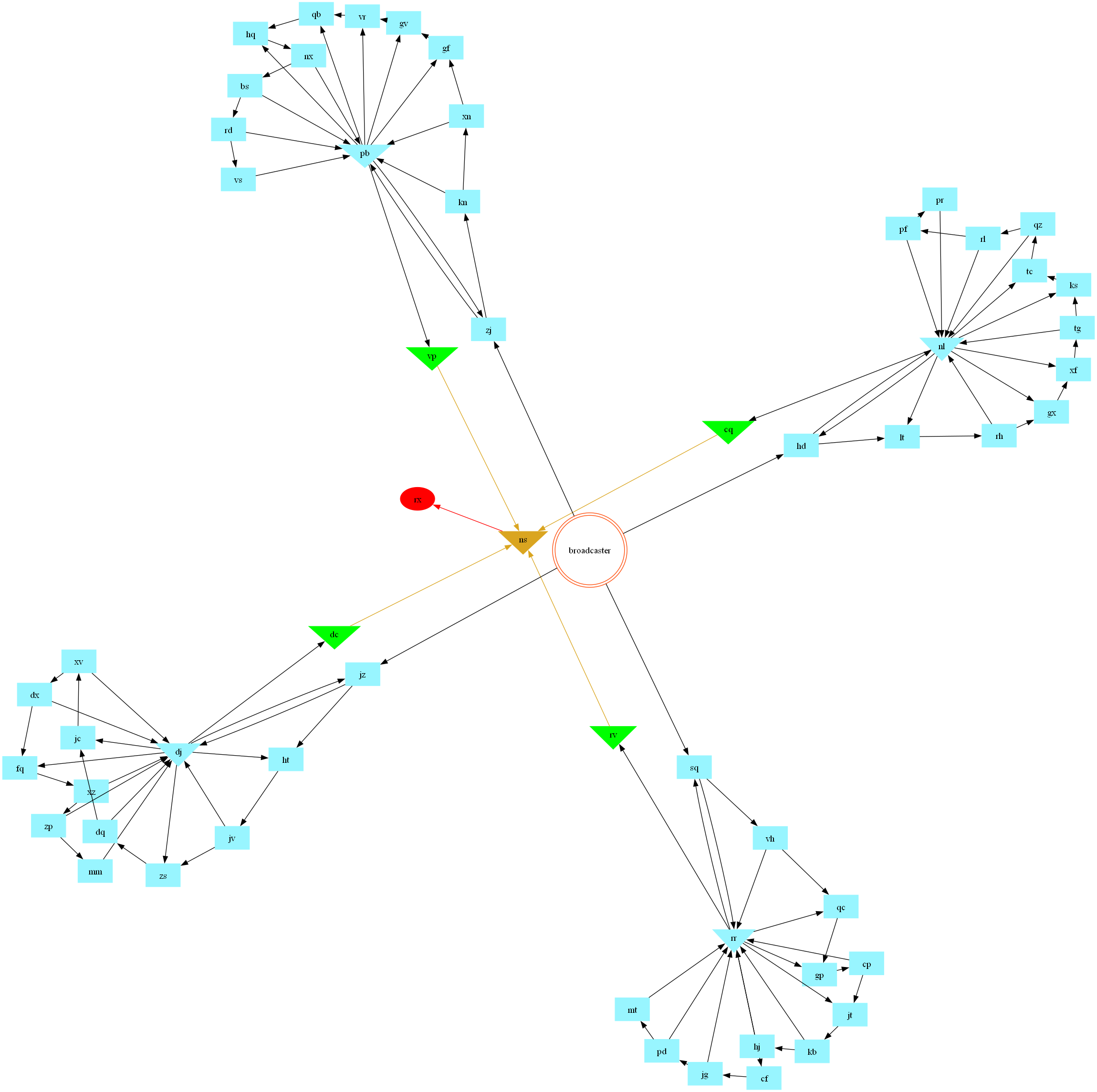
Instead of simulating ( 10^{14} ) steps for all four counters together, measure the cycle period (P_i) of each subgraph independently and combine them with math.lcm(*periods) (built into Python’s standard library since Python 3.9).
Always Verify Zero Phase Offset First
Here is the crucial catch that trips people up every December: math.lcm(*periods) ONLY works when phase_offset == 0 — meaning each loop reaches its trigger at exact integer multiples (k \cdot P_i) (so first_hit == period, with no non-zero lead-in shift and no multiple goal hits per cycle).
Never blindly break on the first goal hit and call math.lcm. Walk until the underlying state repeats in seen, then assert that the full state loop period is a multiple of the first goal hit and that goal hits occur at exact multiples of that period:
import math
from collections.abc import Callable, Hashable, Sequence


def synchronise_zero_offset_cycles[S: Hashable](
    starts: Sequence[S],
    step_fn: Callable[[S], S],
    is_goal: Callable[[S], bool],
) -> int:
    """Combine independent loop periods via math.lcm after verifying zero phase offset."""
    if not starts:
        raise ValueError("starts must not be empty")

    periods: list[int] = []
    for start in starts:
        state = start
        seen: dict[S, int] = {state: 0}
        goal_steps: list[int] = []
        steps = 0

        while True:
            state = step_fn(state)
            steps += 1
            if is_goal(state):
                goal_steps.append(steps)
            if state in seen:
                state_period = steps - seen[state]
                break
            seen[state] = steps

        if not goal_steps:
            raise ValueError(f"Cycle from {start!r} never visits a goal state")

        period = goal_steps[0]
        if state_period % period != 0 or goal_steps != list(range(period, steps + 1, period)):
            raise ValueError(
                f"Non-zero offset or irregular goals (state_period={state_period}, hits={goal_steps}); use CRT instead."
            )
        periods.append(period)

    return math.lcm(*periods)


# Sample graph from 2023 Day 8 Part 2
sample_graph = {
    "11A": ("11B", "XXX"),
    "11B": ("XXX", "11Z"),
    "11Z": ("11B", "XXX"),
    "22A": ("22B", "XXX"),
    "22B": ("22C", "22C"),
    "22C": ("22Z", "22Z"),
    "22Z": ("22B", "22B"),
    "XXX": ("XXX", "XXX"),
}
instr = "LR"


def ghost_step(node_step: tuple[str, int]) -> tuple[str, int]:
    node, idx = node_step
    left, right = sample_graph[node]
    return (left if instr[idx] == "L" else right, (idx + 1) % len(instr))


assert synchronise_zero_offset_cycles(
    [("11A", 0), ("22A", 0)],
    ghost_step,
    lambda st: st[0].endswith("Z"),
) == 6

# Reject non-zero phase offsets (lead-in before period-3 loop: hits at t=2, 5, 8, ...)
shifted_loop = {0: 1, 1: 2, 2: 3, 3: 1}
try:
    synchronise_zero_offset_cycles([0], lambda s: shifted_loop[s], lambda s: s == 2)
    raise AssertionError("Expected ValueError for non-zero phase offset")
except ValueError:
    pass
When phase_offset != 0, math.lcm silently gives the wrong answer — which is the exact boundary where you switch to the Chinese Remainder Theorem.
Modular Ring Wrapping, LCM Modulus, and Modular Inverses
Before tackling CRT, three everyday modular arithmetic habits in Python remove whole categories of off-by-one bugs and integer explosions:
1. Python’s Euclidean % Handles Negative Steps Cleanly
In C, Java, or Rust, -3 % 100 evaluates to -3 (truncation toward zero), forcing defensive (x % m + m) % m wrappers everywhere. Python’s % operator uses floor division, so the remainder always matches the sign of a positive modulus:
assert (-3) % 100 == 97
That makes circular wrapping effortless:
- Circular dial rotation (2025 Day 1): Turning a
0..99dial left or right wraps cleanly with(pos - steps) % 100, and using mirror symmetry turns left-turn zero-crossing counts into a singledivmodwithout nestedif/elifbranches! - Toroidal robot teleportation (
2024 Day 14,/2024/): A robot starting at ((p_x, p_y)) with velocity ((v_x, v_y)) — even negative velocities — jumps straight to second (t) in (O(1)) via:
def turn_dial(pos: int, direction: str, steps: int, dial_size: int = 100) -> tuple[int, int]:
    """Rotate a circular dial and return ``(new_pos, zero_crossings)`` using ``divmod``."""
    if direction == "R":
        crossings, new_pos = divmod(pos + steps, dial_size)
        return new_pos, crossings
    mirrored = (dial_size - pos) % dial_size
    crossings, _ = divmod(mirrored + steps, dial_size)
    return (pos - steps) % dial_size, crossings


# 2025 Day 1 dial wrapping (L5 from 2 -> 97, 1 crossing; L100 from 0 -> 0, 1 crossing)
assert turn_dial(2, "L", 5) == (97, 1)
assert turn_dial(0, "L", 100) == (0, 1)

# 2024 Day 14 sample: p=(2, 4), v=(2, -3) on an 11x7 grid at t=5 -> (1, 3)
assert ((2 + 2 * 5) % 11, (4 + (-3) * 5) % 7) == (1, 3)
2. Clamping Exploding Integers with lcm_modulus = math.lcm(*divisors)
In 2022 Day 11 (Monkey in the Middle) (see monkey.py), Part 2 removes the // 3 relief division and raises rounds from 20 to 10,000. Without clamping, squaring worry values repeatedly creates numbers with hundreds of thousands of digits, stalling Python’s arbitrary-precision arithmetic.
Because only addition and multiplication occur (no division!), modular congruence holds across every monkey’s divisibility check simultaneously if we reduce modulo (M = \operatorname{lcm}(d_1, d_2, \dots, d_k)):
\[(a + b) \bmod M = ((a \bmod M) + b) \bmod M, \qquad (a \cdot b) \bmod M = ((a \bmod M) \cdot b) \bmod M\]import math
divisors = (23, 19, 13, 17)
lcm_modulus = math.lcm(*divisors)
raw_worry = 79
clamped_worry = 79
for _ in range(6):
raw_worry = raw_worry * raw_worry + 3
clamped_worry = (clamped_worry * clamped_worry + 3) % lcm_modulus
assert all((raw_worry % d) == (clamped_worry % d) for d in divisors)
Since every divisor (d_i) divides lcm_modulus, reducing worry %= lcm_modulus leaves every worry % d_i == 0 branch 100% identical while keeping worry small enough to fit inside a single 64-bit integer.
3. Fast Exponentiation and Modular Inverses (pow)
Never write (base ** exp) % mod when exp is large — Python will try to materialise base ** exp in RAM before % ever runs. Always use the built-in three-argument pow(base, exp, mod) for (O(\log \text{exp})) modular exponentiation.
Better still, since Python 3.8+, passing -1 as the exponent computes the modular multiplicative inverse (a^{-1} \bmod m) natively (raising ValueError if (\gcd(a, m) \neq 1)):
# 2020 Day 25 sample Diffie-Hellman handshake (subject=7, loop=8, mod=20201227)
card_pub = pow(7, 8, 20201227)
assert card_pub == 5764801
assert pow(17807724, 8, 20201227) == 14897079

# Modular multiplicative inverse via built-in pow(a, -1, mod)
inv = pow(3, -1, 11)
assert (3 * inv) % 11 == 1
The Chinese Remainder Theorem
Now suppose your sub-cycles do have non-zero phase offsets — the classic AoC setup where you want the earliest timestamp (t \ge 0) satisfying a list of simultaneous congruences:
\[t \equiv r_i \pmod{m_i} \quad \text{for } i = 1, \dots, k\]This pattern turns up directly in two standout puzzles in this repository:
- 2016 Day 15 (Timing is Everything) (
rotating_discks.py): Dropping a capsule at time (t) reaches disc (i) (with (m_i) positions, initially at (p_i)) at time (t + i), so slot0aligns when (p_i + t + i \equiv 0 \pmod{m_i}), i.e. (t \equiv -(p_i + i) \pmod{m_i}). - 2020 Day 13 (Shuttle Search) (
/2020/andbus_schedule_pt2_primes_only.py): Bus (b_i) at index offset (i) departs at (t + i), requiring (t + i \equiv 0 \pmod{b_i}), i.e. (t \equiv -i \pmod{b_i}).
Iterative LCM Step-Sieving
The cleanest everyday AoC solver is iterative LCM step-sieving. You start with t = 0 and step = 1, then incorporate one congruence (rem, mod) at a time:
- Advance
t += stepuntilt % mod == rem % mod. Becausestepis already a multiple of every previous modulus, every step preserves all earlier congruences! - Once aligned, update
step = math.lcm(step, mod)and move to the next congruence.
Even better, using math.lcm instead of plain multiplication means this 12-line sieve handles both coprime and compatible non-coprime moduli gracefully, and detects impossible systems cleanly instead of looping forever:
import math
from collections.abc import Sequence


def solve_congruences_sieve(congruences: Sequence[tuple[int, int]]) -> tuple[int, int]:
    """Solve t == rem (mod m) iteratively via LCM step-sieving.

    Works for both pairwise coprime and compatible non-coprime moduli.
    Returns ``(earliest_t, combined_period)``.
    """
    t = 0
    step = 1
    for rem, mod in congruences:
        if mod <= 0:
            raise ValueError(f"Modulus must be positive, got {mod}")
        target_rem = rem % mod
        next_step = math.lcm(step, mod)
        while t % mod != target_rem:
            t += step
            if t >= next_step:
                raise ValueError(f"Incompatible congruence: t == {rem} (mod {mod})")
        step = next_step
    return t, step


# 2020 Day 13 sample schedule: "7,13,x,x,59,x,31,19" -> 1068781
buses = [(-offset, int(b)) for offset, b in enumerate("7,13,x,x,59,x,31,19".split(",")) if b != "x"]
assert solve_congruences_sieve(buses)[0] == 1068781

# 2016 Day 15 sample discs: (5 pos at 4, 2 pos at 1) -> t = 5
discs = [(-(4 + 1), 5), (-(1 + 2), 2)]
assert solve_congruences_sieve(discs)[0] == 5

# Non-coprime moduli: t == 3 (mod 6) and t == 5 (mod 8) -> t = 21, period 24
assert solve_congruences_sieve([(3, 6), (5, 8)]) == (21, 24)
Closed-Form CRT with Modular Inverses
When all moduli (m_1, m_2, \dots, m_k) are pairwise coprime (for example the prime bus IDs in 2020 Day 13), you can compute (t) directly in closed form without any while loop at all. Let (M = \prod_{i} m_i) and (M_i = M / m_i):
Thanks to Python’s built-in pow(partial, -1, mod), that closed-form textbook formula takes just six lines of code:
import math
from collections.abc import Sequence


def solve_crt_coprime(congruences: Sequence[tuple[int, int]]) -> int:
    """Closed-form CRT using pow(M_i, -1, m_i) for pairwise coprime moduli."""
    total_mod = math.prod(mod for _, mod in congruences)
    total = 0
    for rem, mod in congruences:
        partial = total_mod // mod
        inverse = pow(partial, -1, mod)  # Raises ValueError if not coprime
        total += (rem % mod) * partial * inverse
    return total % total_mod


buses = [(-offset, int(b)) for offset, b in enumerate("7,13,x,x,59,x,31,19".split(",")) if b != "x"]
assert solve_crt_coprime(buses) == 1068781
assert solve_crt_coprime([(-(4 + 1), 5), (-(1 + 2), 2)]) == 5
Which one should you reach for? In practice,
solve_congruences_sievehandles 99% of Advent of Code inputs in microseconds and won’t break if two periods happen to share a common factor — whereassolve_crt_coprimeshines when moduli are astronomically huge primes where even iterating up tomodinside awhileloop would take too long.
AoC Examples
| Puzzle | Technique | Link / Source |
|---|---|---|
| 2016 Day 15 — Timing is Everything | Simultaneous congruences (CRT / step-sieving) | Walkthrough / rotating_discks.py |
| 2017 Day 6 — Memory Reallocation | Lead-in + cycle period via tuple state hashing |
2017 Index / Notebook |
| 2020 Day 13 — Shuttle Search | Iterative LCM sieving & closed-form CRT | 2020 Index / bus_schedule_pt2_primes_only.py |
| 2020 Day 25 — Combo Breaker | Modular exponentiation pow(base, exp, mod) |
2020 Index / door_handshake.py |
| 2022 Day 11 — Monkey in the Middle | Clamping worry explosion via math.lcm(*divisors) |
Walkthrough / monkey.py |
| 2022 Day 17 — Pyroclastic Flow | Cumulative height-delta jumping with (rock_idx, jet_idx, skyline) |
Walkthrough / tetris.py |
| 2023 Day 8 — Haunted Wasteland | Synchronising zero-offset ghost loops via math.lcm |
2023 Index / Notebook |
| 2023 Day 14 — Parabolic Reflector Dish | 1_000_000_000 tilt cycles via hashed 2D grid tuples |
2023 Index / Notebook |
| 2023 Day 20 — Pulse Propagation | Four independent binary-counter subgraphs via math.lcm |
2023 Index / Notebook |
| 2024 Day 14 — Restroom Redoubt | Toroidal (p + v * t) % size wrapping with negative velocities |
2024 Index / Notebook |
| 2025 Day 1 — Secret Entrance | Circular dial wrapping & divmod boundary crossings |
Walkthrough / d01.py |