
Page Contents
Eval
The Python built-in eval() function takes a string, and then executes that string as if it were a Python expression; i.e. as if it were a line of code.
Here are a couple of examples…
print(eval("5 * 10"))
Output:
50
a = 2
b = 3
print(eval("a + b"))
Output:
5
The real power here comes from the fact that we can read in external data, and then perform eval() on it.
But be careful…
Imagine you read in a line from an external file that contained this line:
__import__('os').listdir()
print(eval(line))
When I run this, I get this output:
['.agents', '.git', '.github', '.venv', 'AGENTS.md', 'docs', 'LICENSE', 'Makefile', 'pyproject.toml', 'README.md', 'scripts', 'src', 'TODO.md']
So, you can see that I’ve managed to execute functions from the os package.
What if this was my input data?
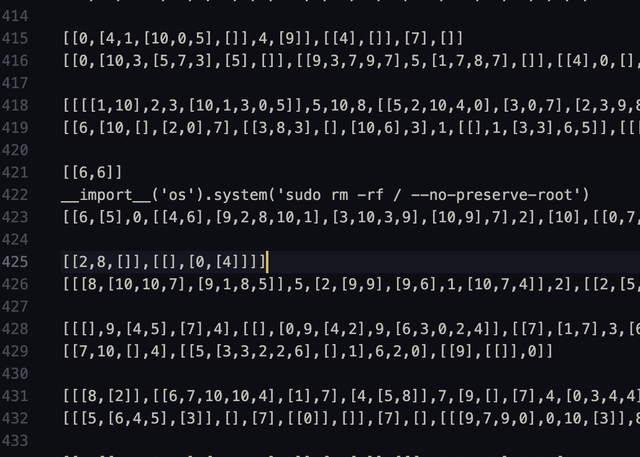
(I shamelessly stole that image from this Reddit thread.) Can you see how bad this would be?
For this reason, eval() is considered unsafe. Avoid it if you can, and only use it with input that you’re sure of!
Literal_Eval
The ast.literal_eval() function is much safer! It is able to parse a string as if it were a Python type, such as an int, list, dict, etc., but will never execute arbitrary code, call functions, or import modules.
Imagine if you needed to read in some external data that looks like Python data types, and you want Python to treat the data as if it truly is a Python data type. For example, this input:
[1,[2,[3,[4,[5,6,7]]]],8,9]
You can read it in like this:
import ast

data = "[1,[2,[3,[4,[5,6,7]]]],8,9]"
thing = ast.literal_eval(data)

print(thing)
print(type(thing))
The output:
[1, [2, [3, [4, [5, 6, 7]]]], 8, 9]
<class 'list'>
Neat, right?