Problem Intro
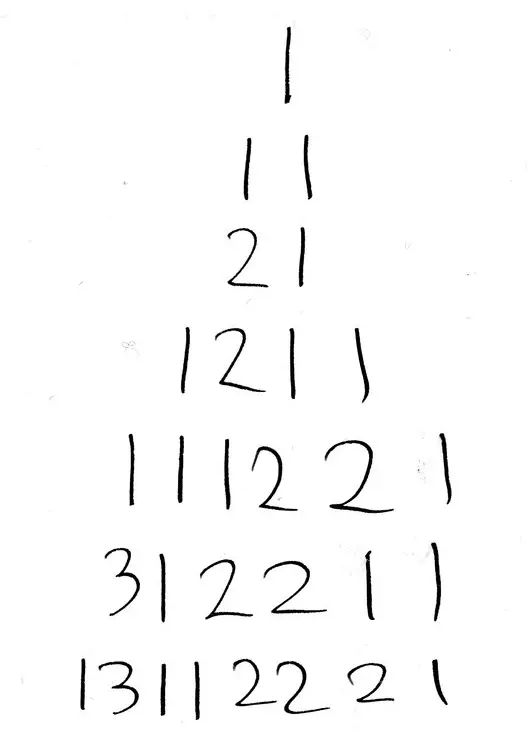
This one is quite a simple challenge. We have to read a sequence, and count how many digits there are in any group of the same digit. We say this count aloud, and this forms the next iteration of the sequence. E.g.
- Iteration 1: 1 becomes 11 (1 copy of digit 1).
- Iteration 2: 11 becomes 21 (2 copies of digit 1).
- Iteration 3: 21 becomes 1211 (one 2 followed by one 1).
- Iteration 4: 1211 becomes 111221 (one 1, one 2, and two 1s).
And so on.
Part 1
How long is our resulting sequence after 40 iterations?
Here’s my function that does the hard work:
def look_and_say(data: str) -> str:
    """ Perform a single look_and_say iteration

    Args:
        data (str): The input string, which is a seequence of numbers

    Returns:
        str: The resulting look-and-say string
    """
    digit_counts = []   # store each count as a (count, digit) tuple, e.g. [(3, 1), (2, 2), (1, 1)]
    digit_count = 0
    prev_digit = None
    for digit in data:
        if (prev_digit and digit != prev_digit):
            # if this digit is different to last digit, store the count of the last digit, and reset the count
            digit_counts.append([digit_count, prev_digit])
            digit_count = 0

        digit_count += 1
        prev_digit = digit

    digit_counts.append([digit_count, prev_digit])

    return "".join(str(count) + str(digit) for count, digit in digit_counts)
It’s pretty simple. It takes a sequence of numeric digits (as a str), and outputs the next sequence.
- It iterates through each digit in the sequence.
- If we’ve just read a digit that is different to the previous digit, then:
- We’ve completed our preceding block of 1 or more identical digits.
- Store, in a tuple:
(count, digit)
- If the current digit is the same as a the previous digit, increment our counter for this block of identical digits.
Finally, when we exit the loop, we use "".join() along with a list comprehension, to assemble our new digit sequence from all the (count, digit) pairs that we have in our list.
Finally, we want to run this function for the required number of iterations:
ITERATIONS = 40

def main():
    input_file = os.path.join(SCRIPT_DIR, INPUT_FILE)
    with open(input_file, mode="rt") as f:
        data = f.read()

    print(f"Input data: {data}")

    for _ in range(ITERATIONS):
        data = look_and_say(data)

    print(f"After {ITERATIONS} iterations, length of result is {len(data)}")
Easy!
Part 2
We’re asked to now perform 50 iterations, and then determine the final output length.
We don’t need to change anything except the value of the ITERATIONS constant!
My output looks like this:
Input data: 1321131112
After 50 iterations, length of result is 6989950
Execution time: 8.8330 seconds
So, it runs in just under 9 seconds. We can probably do better, but this is good enough.